


What if your standard cholesterol panel is only telling half the story about your heart’s true condition? You likely already believe that staying active and monitoring your diet are the primary keys to longevity, yet the nagging worry about "silent" risks often persists. It’s a valid concern, especially since research from the American Heart Association indicates that individuals with hs-CRP levels exceeding 3.0 mg/L face a significantly higher risk of cardiovascular events than those with lower readings. Finding an hs-crp test phoenix shouldn’t be a hurdle in your wellness journey, nor should it require a complex web of referrals and waiting rooms.
You’re going to discover how this high-sensitivity biomarker identifies microscopic inflammation that standard tests often miss. We’ll clarify the technical differences between general CRP and hs-CRP so you can make informed decisions about your pathology results. This guide provides a clear look at how residents in Gilbert, Chandler, and Mesa can access private screenings and use those insights to build a proactive heart health strategy for 2026 and beyond. We’ve simplified the process so you can move from uncertainty to clinical certainty with ease.
Key Takeaways
- Learn how the high-sensitivity C-reactive protein test acts as a precise biomarker to detect low-level, chronic inflammation that standard screenings often miss.
- Understand your specific cardiovascular risk profile by breaking down the three key mg/L categories to identify where you stand on the wellness spectrum.
- Discover the seamless, insurance-free process to secure an hs-crp test phoenix residents can access through convenient partner labs in Scottsdale, Gilbert, and Chandler.
- Take control of your heart health by moving from reactive care to proactive lifestyle choices with data-driven insights that prioritize your privacy and peace of mind.
Table of Contents
-
What is a High-Sensitivity C-Reactive Protein (hs-CRP) Test?
-
Interpreting Your Results: What the Numbers Mean for Your Risk
What is a High-Sensitivity C-Reactive Protein (hs-CRP) Test?
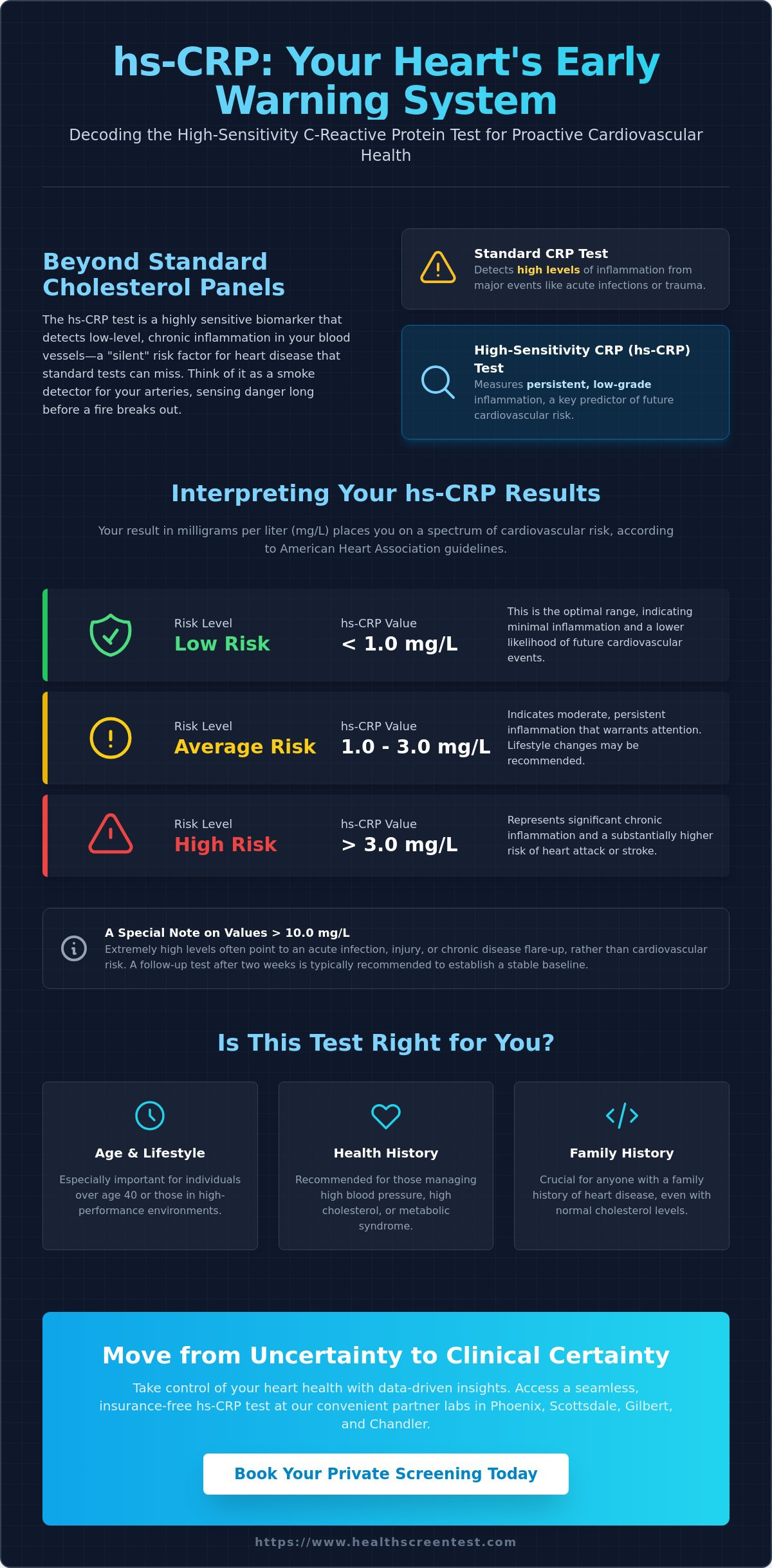
Your liver produces a specific biomarker called C-reactive protein (CRP) whenever your body detects an injury, infection, or chronic threat. While a standard CRP test identifies major health events like acute infections or trauma, the high-sensitivity version (hs-CRP) measures much lower, persistent levels of inflammation. This precision makes the hs-crp test phoenix a vital tool for identifying cardiovascular risks that traditional screenings often miss.
Think of this test as a smoke detector for your arteries. It doesn’t just tell you if there’s a fire; it senses the invisible heat building up before a flame ever appears. In 2026, medical professionals recognize this low-grade inflammation as a primary driver of heart events, even in patients with perfect cholesterol scores. It’s a proactive way to look beneath the surface of your health.
To better understand how this biomarker impacts your wellness journey, watch this expert explanation:
The Role of Inflammation in Heart Disease
Inflammation is often called a silent killer because it works behind the scenes to destabilize the lining of your blood vessels. This process contributes to atherosclerosis, where plaque builds up and narrows your arteries. You can learn more about how this differs from standard testing in our sibling guide on the Heart Inflammation Test in Tempe. Even if your LDL levels are within a healthy range, high inflammation acts like a corrosive force on your arterial walls, increasing the risk of sudden cardiac events.
Who Should Consider an hs-CRP Test?
This screening is particularly important for individuals over age 40 or those managing high blood pressure and family histories of heart disease. For residents in high-performance environments like Phoenix and Mesa, staying ahead of these "silent" markers is a proactive lifestyle choice. It’s about data-driven peace of mind. If you’re ready to take control, you can explore our comprehensive health screenings to find the right path for your specific needs.
** Key Takeaways**
-
Precision: Measures low-level, chronic inflammation that standard tests miss.
-
Preventive Power: Acts as an early warning system for heart disease before symptoms appear.
-
Accessibility: A staple of modern 2026 preventive care for those over 40 in Arizona.
-
Control: Provides actionable data to help you optimize your lifestyle and reduce cardiac risk.
Interpreting Your Results: What the Numbers Mean for Your Risk
Your lab report provides a numerical value that places you into a specific risk bracket for cardiovascular disease. According to guidelines from the American Heart Association and the Mayo Clinic, these ranges help predict your likelihood of future heart events. If you’ve scheduled an hs-crp test phoenix residents should know that a result below 1.0 mg/L indicates low risk. A range between 1.0 and 3.0 mg/L signifies average risk, while anything above 3.0 mg/L puts you in the high-risk category.
Think of this biomarker as a snapshot of your body’s current state. If your levels exceed 10.0 mg/L, it often points to an acute infection, a recent injury, or a flare-up of a chronic condition rather than long-term heart-related inflammation. Because of this variability, doctors typically recommend a second test two weeks later to ensure the data is consistent and not just a temporary spike. Understanding Interpreting Your hs-CRP Results helps you distinguish between a passing cold and a genuine cardiac concern.
Factors That Influence Inflammation in Arizona
Living in the Valley of the Sun presents unique environmental challenges. Phoenix heat often exceeds 110 degrees for weeks at a time, which can physically stress the body and elevate inflammatory markers. Poor air quality days in Maricopa County also contribute to systemic irritation. You can manage these levels by prioritizing hydration and choosing anti-inflammatory foods, even when a fast-paced urban schedule makes it difficult. Managing daily stress is equally vital for maintaining a healthy baseline in our growing desert metropolis.
Why hs-CRP Works Best with a Lipid Panel
Inflammation is only one piece of the puzzle. To get a complete view of your cardiovascular health, you should look at your inflammation alongside your LDL cholesterol in Mesa. High cholesterol levels act as the fuel, while hs-CRP acts as the fire. When both are elevated, the risk of plaque rupture increases significantly. Taking a proactive approach allows you to see the whole picture rather than focusing on a single marker. If you’re ready to check your markers, you can view our available screenings
How to Secure an hs-CRP Test in Phoenix and the East Valley
Accessing a professional hs-crp test phoenix doesn’t have to involve long wait times or complex insurance paperwork. Our streamlined process allows you to order your screenings online without a prior doctor’s referral. This direct-to-consumer model puts you in charge of your diagnostic journey. You can choose from our extensive network of partner lab locations in Scottsdale, Gilbert, and Chandler, or look for one of our mobile screening events scheduled throughout 2026. These local options ensure that high-quality pathology services are always within a short drive from your home.
"I hadn’t seen a doctor in over two years because of the scheduling hassle, but I knew I needed to check my heart health," explains David, a 58-year-old Gilbert resident. "The hs-CRP test gave me a clear baseline. It was fast, private, and the results arrived in my inbox within 48 hours. That kind of clarity is exactly what I needed to stop worrying and start acting."
Preparing for Your Phlebotomy Appointment
Your visit to the lab will be quick and efficient. While a standard C-reactive protein test typically doesn’t require fasting, you should check your specific order details. If you’ve combined this screening with a Heart Health Panel in Sun City West, an 8 to 12-hour fast is usually necessary for accurate results. Drink plenty of water before your appointment to stay hydrated, as this makes the phlebotomy process much smoother. Try to arrive a few minutes early so you can sit quietly and stay relaxed before the blood draw.
Taking Control of Your Cardiovascular Future
Data is the ultimate form of empowerment. When you understand your specific biomarkers, you can make targeted lifestyle changes that actually move the needle on your long-term wellness. We believe that health information should be accessible and actionable for everyone, regardless of their medical history. If you’re ready to explore a full range of diagnostic tools, visit our comprehensive screenings page to find the right path for your specific needs. Taking this step today ensures a more informed and healthier tomorrow.
Frequently Asked Questions
-
Do I need a prescription for this test? No, you can order directly through our platform without a doctor’s order.
-
How soon will I get my results? Most results are delivered securely to your portal within 24 to 48 hours.
-
Is the test covered by insurance? We provide a private-pay model to ensure your data stays confidential and the process remains seamless.
Related Posts
Empower Your Heart Health Journey Today
Your cardiovascular wellness shouldn’t be a mystery left to chance. Monitoring high-sensitivity C-reactive protein levels provides a clear window into systemic inflammation that standard cholesterol panels often miss. According to the Centers for Disease Control and Prevention (CDC), heart disease accounts for one in every five deaths in the United States, making a proactive hs-crp test phoenix a vital tool for anyone over 40. You’ll gain precise insights into your risk profile, allowing you to make informed lifestyle adjustments with professional confidence. We’ve removed the traditional barriers to diagnostic data; you don’t need a doctor’s order or insurance coverage to take control of your results. With access to thousands of convenient lab locations and secure online reporting within 24 to 48 hours, the path to clarity is seamless. It’s time to prioritize your peace of mind and embrace a future built on data-driven health choices. Book Your hs-CRP Test and Heart Health Screening Today. You deserve the certainty that comes from professional pathology and personalized care.
Frequently Asked Questions
Is the hs-CRP test the same as a regular CRP test?
No, the hs-CRP test isn’t the same as a standard CRP test because it measures much smaller concentrations of C-reactive protein in your blood. While a standard test identifies major inflammation from acute infections, the high-sensitivity version detects levels between 0.5 and 10 mg/L. This precision allows us to assess your subtle risk for cardiovascular issues that a regular test would simply miss.
Do I need to fast before my hs-CRP blood test in Phoenix?
You don’t need to fast specifically for an hs-crp test phoenix appointment, but you might need to if other tests are ordered simultaneously. If your screening includes a glucose or cholesterol panel, you’ll likely need to avoid food for 9 to 12 hours. Staying hydrated with water is always encouraged to make the blood draw as seamless and comfortable as possible for you.
What can cause a temporary spike in hs-CRP levels?
Minor infections, recent physical trauma, or even a strenuous workout in the last 24 hours can cause your levels to spike temporarily. According to clinical data, a reading higher than 10 mg/L usually indicates a short-term issue like a cold or a flare-up of a chronic condition. We typically suggest waiting 14 days after you’ve recovered before retesting to ensure we capture your baseline health accurately.
How often should I have my inflammation levels checked?
Most adults over 40 should consider an inflammation check every 1 to 3 years depending on their overall heart disease risk profile. The American Heart Association notes that for those with an intermediate risk of 5% to 7.5% over a decade, this test provides essential data for personalized care. Frequent monitoring helps you take control of your wellness journey through actionable, data-driven insights.
 Article by
Alexander Aquino, RN
With over 35 years of dedicated service within the healthcare industry, I’ve witnessed firsthand the profound difference early detection can make in saving lives. This experience has ignited my mission to empower individuals to take control of their healthcare before challenges arise.
Throughout my career in both nursing and medicine, I have worked in inpatient hospitals and outpatient clinical settings. I’ve dedicated myself to one unwavering principle: prevention saves lives. Every day in healthcare reinforces this truth—the earlier we detect potential health issues, the better the outcomes for patients.
Article by
Alexander Aquino, RN
With over 35 years of dedicated service within the healthcare industry, I've witnessed firsthand the profound difference early detection can make in saving lives. This experience has ignited my mission to empower individuals to take control of their healthcare before challenges arise.
Throughout my career in both nursing and medicine, I have worked in inpatient hospitals and outpatient clinical settings. I've dedicated myself to one unwavering principle: prevention saves lives. Every day in healthcare reinforces this truth—the earlier we detect potential health issues, the better the outcomes for patients.
Disclaimer
Health Screen Test does not provide medical advice, diagnosis, treatment, or prescription services, nor does it bill insurance. The content presented in this blog is intended solely for educational purposes to help you make informed decisions before purchasing any screening tests. By clicking on an affiliate link, you will be redirected to the respective screening company’s website. Please consult your physician for personalized medical advice. Kindly note that I may receive a small commission from purchases made through affiliate links.