


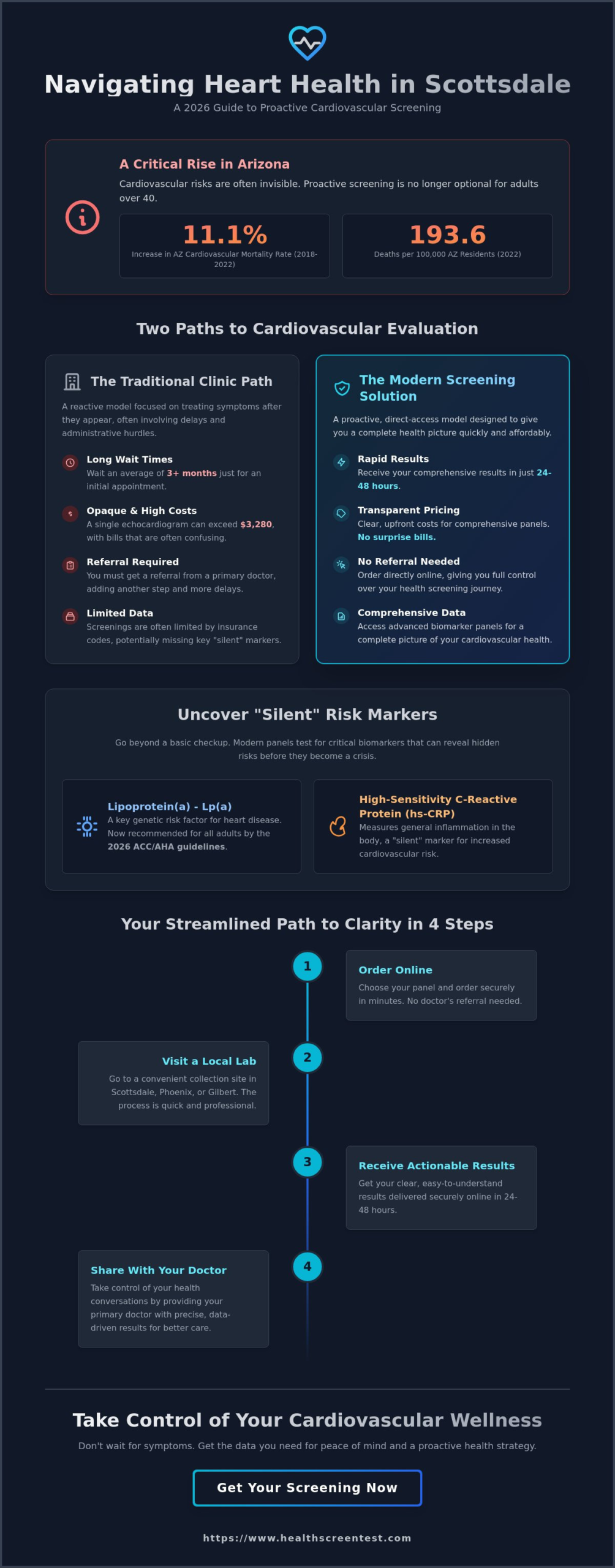
Arizona’s cardiovascular mortality rate climbed by 11.1% between 2018 and 2022, a statistic that proves why proactive screening is no longer optional for adults over 40. You probably recognize the frustration of trying to secure an appointment at a traditional Scottsdale heart health clinic, only to be met with three month wait times or confusing bills that might exceed $3,280 for a standard echocardiogram. It is unsettling to feel like “silent” markers are being missed while you wait for a system that feels reactive rather than preventive.
We believe your peace of mind shouldn’t be gated by specialist referrals or a lack of pricing transparency. This 2026 guide explains how to access comprehensive cardiovascular screenings in Scottsdale with speed and scientific precision. You’ll learn how to identify critical biomarkers like Lipoprotein(a), which the 2026 ACC/AHA guidelines now recommend for all adults, and how to obtain clear, actionable data you can take directly to your primary doctor. We will walk you through the most efficient ways to monitor your arterial health and take full control of your long term wellness journey.
Key Takeaways
- Learn the critical differences between a traditional Scottsdale heart health clinic and direct-to-consumer preventive screening services to save on costs and bypass long wait times.
- Use our 2026 comparison data to evaluate the time, expense, and depth of biomarkers provided by various local cardiovascular evaluation options.
- Discover how comprehensive panels, such as the Cardiovascular Panel and gender-inclusive packages, provide a more complete health picture than basic screenings.
- Follow a simple, step-by-step process to order your heart health screenings online and access convenient collection sites across Scottsdale, Phoenix, and Gilbert.
- Gain the clinical insights needed to take control of your cardiovascular wellness and provide your primary doctor with precise, data-driven results for better care.
Understanding Heart Health Screening Options in Scottsdale
When searching for the right Scottsdale heart health clinic, it’s easy to get lost in a sea of hospital systems and specialist referrals. Most residents don’t realize there’s a massive difference between a traditional cardiology office and a preventive screening service. Traditional clinics are fundamentally reactive; they focus on treating symptoms that already exist. A preventive service focuses on cardiovascular risk screening to find issues before they become life-threatening emergencies.
Heart disease remains the leading cause of death in the United States, claiming approximately 695,000 lives in 2022. In Arizona alone, the mortality rate for cardiovascular disease was 193.6 per 100,000 residents in the same year. For adults over 40, these numbers prove why baseline testing is a necessity. Knowing your biomarkers provides the factual certainty needed to manage your health with confidence.
To better understand how lifestyle choices and exercise support your long term heart resilience, watch this video from leading medical professionals:
The Shift Toward Proactive Cardiovascular Care
Cardiovascular risks are often invisible. Plaque and inflammation can build up for decades without a single symptom. This is especially dangerous in the Arizona heat, where high temperatures put extra strain on the heart. By identifying markers like high-sensitivity C-Reactive Protein early, you can take action long before a crisis occurs. Catching these “silent” markers allows for lifestyle adjustments that significantly improve long term outcomes.
Traditional Cardiology vs. Direct-to-Consumer Screening
Networks like HonorHealth provide vital surgical care, but they function on a referral-based model. This often means waiting weeks for an appointment. Direct access through Health Screen Test allows you to bypass these delays. You get professional pathology and clear results without needing a doctor’s permission first. This streamlined approach offers a modern solution for those who value their time, privacy, and proactive wellness.
Key Takeaways
- 🔍 Preventive Screening: Designed to detect silent risks in healthy individuals before symptoms appear.
- 🏥 Traditional Clinics: Best for managing diagnosed conditions, prescriptions, or surgical interventions.
- ⚡ Direct Access: Bypasses the referral system, allowing for faster results and transparent costs.
What to Look for in a Scottsdale Cardiovascular Evaluation
Choosing the right path for heart monitoring requires looking at more than just a provider’s credentials. When you’re figuring out how to choose a heart specialist, the conversation usually revolves around insurance networks and specialist referrals. However, a modern Scottsdale heart health clinic should prioritize accessible, high-level data that you can actually use. For many residents, the traditional route involves layers of administrative hurdles that don’t necessarily lead to better insights.
| Feature | Traditional Clinical Visit | Direct-to-Consumer Screening |
|---|---|---|
| Typical Cost | $150+ for initial consult | Transparent package pricing |
| Time to Results | Weeks for appointments | 24 to 48 hours |
| Referral Needed | Yes, usually required | Never required |
| Depth of Data | Varies by insurance code | Comprehensive biomarker panels |
Our approach centers on providing a full health picture through the Mens Comprehensive Package and the Cardiovascular Panel. These options ensure that all Scottsdale residents, regardless of gender identity, have access to sophisticated testing. This isn’t just about checking a box; it’s about obtaining a baseline that allows for proactive lifestyle adjustments.
Essential Heart Markers: Beyond Basic Cholesterol
A standard cholesterol test only scratches the surface of your risk profile. To truly understand vascular health, you need to measure inflammation through high-sensitivity C-Reactive Protein (hs-CRP). This marker identifies irritation in the arterial walls that traditional tests often miss. You can learn more about this in our guide on Heart Inflammation Test in Tempe: Detecting Silent Risks Beyond Cholesterol. We also include a Lipid Panel with Ratios, which offers a much more accurate assessment than total cholesterol numbers alone.
Structural vs. Biomarker Testing
It’s important to understand the difference between structural tests and blood pathology. Structural evaluations, like an EKG or an echocardiogram (which can cost an average of $3,280 in Scottsdale), look at the physical heart muscle and valves. Biomarker testing, however, looks at the chemical drivers of disease. Research from the Cleveland Clinic suggests that managing these blood-based risk factors early is the most effective way to prevent future cardiac events. By starting with a comprehensive screening, you get the data needed to make informed decisions without the high costs of hospital-based diagnostics.
Accessing Affordable Heart Screenings in the Scottsdale Area
High overhead costs at traditional medical centers often lead to inflated prices for patients. When you visit a standard Scottsdale heart health clinic, you’re frequently paying for administrative layers and facility fees that don’t directly improve the quality of your data. Direct-to-consumer testing offers a leaner, more efficient alternative. By removing the middleman, you can explore comprehensive heart health screening options that fit your schedule and your budget.
Our model prioritizes your convenience through a network of mobile and fixed collection sites. Whether you are in Scottsdale, Phoenix, or Gilbert, professional phlebotomy services are rarely more than a short drive away. This accessibility ensures that staying proactive about your cardiovascular health doesn’t require a day off work or a stressful trek to a hospital campus.
“After turning 52, I wanted a baseline check without the hassle of a referral. My screen caught an elevated A1c and high hs-CRP that my yearly physical had missed. It was the wake-up call I needed to adjust my lifestyle before a real problem developed.” – J. Miller, Scottsdale Resident.
How to Schedule Your Screening Without a Doctor
The process of securing your data is straightforward and designed to minimize stress. First, you select your desired panel online. There’s no need for insurance paperwork or a doctor’s order. Once you’ve placed your order, you simply visit a local lab or mobile site for a quick blood draw. You can find more details on this streamlined approach in our Cardiac Screening in Phoenix & Gilbert, AZ: Your Complete 2026 Guide. Your results are delivered through a secure digital portal, maintaining strict confidentiality and privacy at every step.
Interpreting Your Results and Next Steps
Receiving your results is just the beginning of your wellness journey. We provide clear, easy-to-read reports that highlight any biomarkers outside the optimal range. We recommend bringing these results to your primary care provider. This data allows for a much more productive conversation, as you’re providing them with a precise map of your internal health. You can Learn About Health Screen Test and our commitment to making high-level diagnostic data accessible to everyone. Taking control of your health shouldn’t be a daunting clinical event; it’s a proactive lifestyle choice that provides lasting peace of mind.
Taking Charge of Your Cardiovascular Future
Securing your heart health doesn’t have to be a reactive response to symptoms. As we explored, the March 2026 ACC/AHA guidelines now emphasize earlier, more personalized risk assessments, including one-time Lp(a) screenings for all adults. By shifting your focus from a traditional, referral-heavy Scottsdale heart health clinic to a direct-to-consumer model, you gain immediate access to high-level pathology. You no longer need to wait months for a consultation just to understand your basic cardiovascular markers.
Empowerment comes through data. When you choose a private screening path, you receive results typically available within 24 to 48 hours. There is no doctor’s order or insurance required; you simply select the panel that fits your needs. With access to thousands of convenient mobile screening locations, professional care is always nearby. Taking this step provides the clarity you need to work effectively with your healthcare team. Order Your Comprehensive Heart Health Screening Today. Your long-term wellness is built on the decisions you make today. We are here to provide the accurate, discreet insights you deserve for a healthier, more confident life.
Frequently Asked Questions
Do I need a doctor’s order to get a heart screening in Scottsdale?
No, you don’t need a physician’s referral or a prior prescription to access our testing services. While a traditional Scottsdale heart health clinic often requires an initial primary care visit to authorize lab work, our direct-to-consumer model allows you to self-select the panels you need. This streamlined approach eliminates the typical two to twelve week wait for a specialist appointment, giving you immediate control over your cardiovascular data.
How much does a comprehensive heart health panel cost compared to a clinic visit?
Direct screenings are generally more affordable because they remove hospital facility fees and specialist consultation charges. In 2026, an initial consultation at a local wellness center costs approximately $150, and a standard echocardiogram in the Scottsdale area averages $3,280. By choosing a direct screening service, you bypass these high overhead costs and receive a bundle of critical biomarkers in one transparently priced package.
Are these screenings covered by health insurance or HSA/FSA?
We don’t offer direct insurance billing for our screening services to keep our processes fast and discreet. However, most biomarker tests are considered eligible expenses for Health Savings Accounts (HSA) and Flexible Spending Accounts (FSA). Since heart disease is the leading cause of death in Arizona, resulting in 14,344 deaths in 2022, many residents find that using their pre-tax health accounts for proactive screening is a wise investment in their long-term wellness.
What is the difference between a lipid panel and a full cardiovascular risk assessment?
A standard lipid panel only measures cholesterol and triglycerides, while a full cardiovascular risk assessment analyzes deeper markers of arterial health. A comprehensive assessment includes tests for inflammation, such as hs-CRP, and metabolic markers like Hemoglobin A1c. This distinction is vital because 9.5% of Arizona adults have been diagnosed with heart conditions, and many of these individuals may have had standard cholesterol levels that failed to reveal their true risk profile.

Article by
Alexander Aquino, RN
With over 35 years of dedicated service within the healthcare industry, I've witnessed firsthand the profound difference early detection can make in saving lives. This experience has ignited my mission to empower individuals to take control of their healthcare before challenges arise.
Throughout my career in both nursing and medicine, I have worked in inpatient hospitals and outpatient clinical settings. I've dedicated myself to one unwavering principle: prevention saves lives. Every day in healthcare reinforces this truth—the earlier we detect potential health issues, the better the outcomes for patients.
Disclaimer
Health Screen Test does not provide medical advice, diagnosis, treatment, or prescription services, nor does it bill insurance. The content presented in this blog is intended solely for educational purposes to help you make informed decisions before purchasing any screening tests. By clicking on an affiliate link, you will be redirected to the respective screening company’s website. Please consult your physician for personalized medical advice. Kindly note that I may receive a small commission from purchases made through affiliate links.