More than 1 in 4 women over the age of 65 in the United States currently live with osteoporosis, a condition that often progresses silently until a sudden injury occurs. For proactive residents in the Valley, securing a bone density screening Phoenix is the most effective way to identify bone thinning before it impacts your mobility. You likely want to maintain your independence and avoid the frustration of navigating complex insurance requirements just to get a simple preventive test. It’s common to feel overwhelmed by medical jargon or the fear of what a scan might reveal.
This guide provides the clarity you need to protect your skeletal health with confidence. We’ll show you how to access advanced DEXA screenings in the Phoenix area without a doctor’s referral, saving you time and reducing clinical stress. You will learn about the updated 2025 USPSTF guidelines, the reality of screening costs, and how to interpret your results. By taking control of your diagnostic journey today, you can build a clear roadmap for a stronger, more active future.
Key Takeaways
- Learn why osteoporosis is known as a silent disease and how monitoring bone mineral density helps prevent unexpected fractures.
- Identify if you fall into high-risk categories, including post-menopausal individuals or those with a family history of bone loss.
- Discover the painless and non-invasive DEXA scan process used to provide accurate data about your skeletal health.
- Find out how to easily book a bone density screening Phoenix without requiring a doctor’s referral or navigating insurance hurdles.
- Take control of your health with affordable, direct-to-consumer assessments that offer a clear path toward long-term mobility.
Understanding Bone Density Screening and Osteoporosis Risk
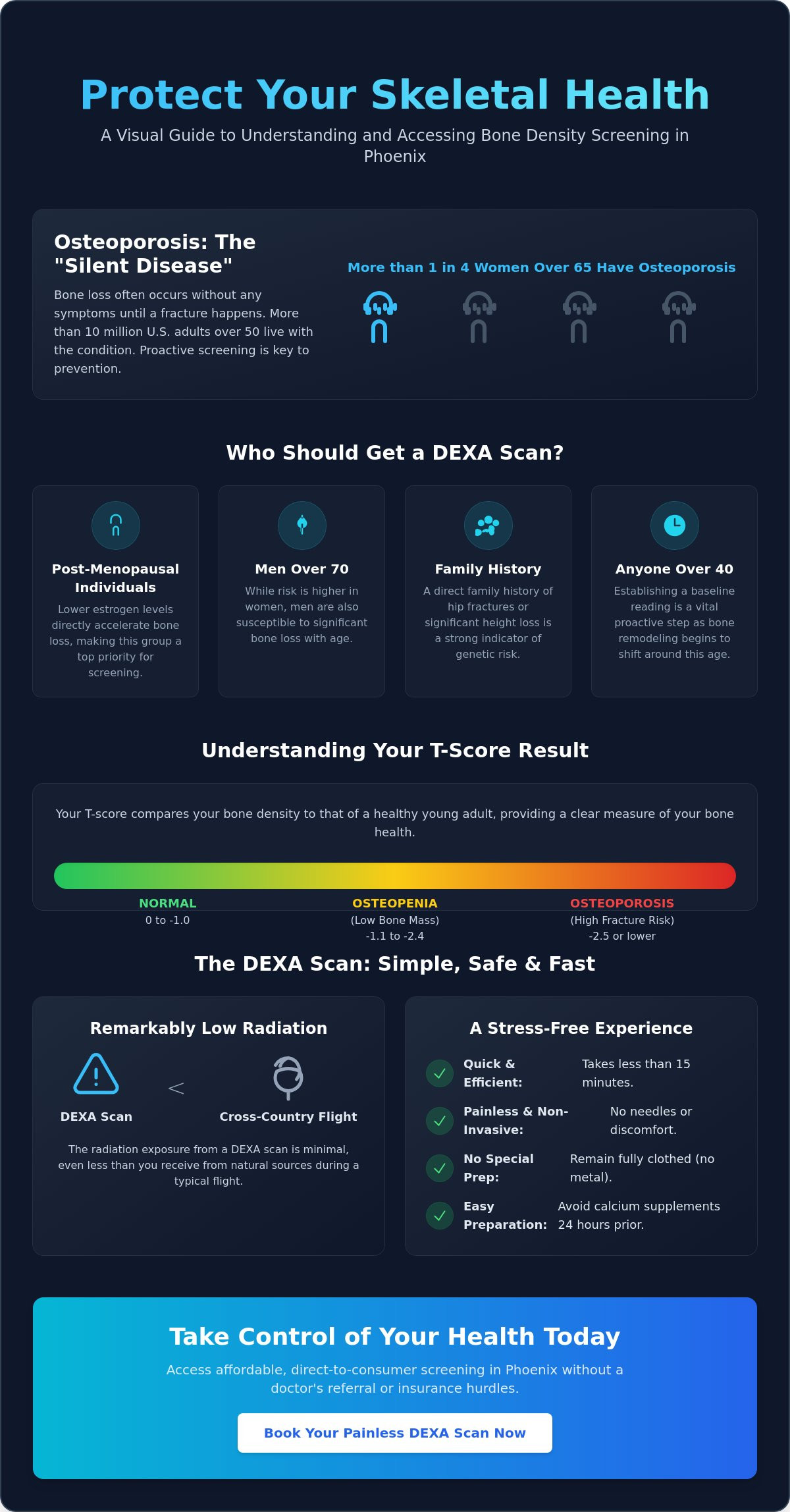
Bone Mineral Density (BMD) serves as the primary yardstick for skeletal health, measuring the concentration of essential minerals within your bone segments. Because bone loss typically occurs without pain or visible symptoms, osteoporosis is frequently identified as a silent disease that progresses unnoticed until a fracture happens. According to the CDC, over 10 million adults in the U.S. over age 50 currently live with this condition, while millions more have low bone mass. Establishing a baseline through a DEXA Scan is a vital proactive step for individuals of all genders, particularly as they reach the age of 40 and bone turnover begins to shift.
To visualize how these clinical measurements translate to your daily health, watch this brief overview:
The Science of Osteoporosis and Osteopenia
Osteopenia represents the early stage of bone thinning, serving as a critical warning that your density is lower than the healthy average. Osteoporosis marks a more severe loss of density that significantly increases the risk of life-altering fractures. After age 40, the natural process of bone remodeling shifts, as the body begins to resorb old bone cells faster than it can generate new ones. While the abundant Phoenix sun helps with Vitamin D synthesis for calcium absorption, local lifestyle factors and biological changes still necessitate regular monitoring. A bone density screening Phoenix provides the data needed to manage these changes effectively.
Key Takeaways for Preventive Care
Prioritizing an early scan offers several long-term advantages for your wellness journey:
- 📍 Fracture prevention: Identifying skeletal vulnerabilities before a break occurs.
- 📊 Baseline tracking: Creating a data-driven history to monitor your bone health over time.
- 🛡️ Peace of mind: Eliminating the anxiety of hidden bone loss with factual, clinical certainty.
Since bone health is closely linked to internal biological balance, you might also find our hormone testing for women phoenix guide helpful for understanding the hormonal factors that influence bone turnover.
Who Should Get a DEXA Scan and What to Expect
Understanding who benefits from a Bone Density Scan helps you stay ahead of potential health shifts as you age. While anyone over 40 can benefit from a baseline, certain groups face higher risks. Post-menopausal individuals are at the top of the list because lower estrogen levels accelerate bone loss, making a regular bone density screening Phoenix a vital part of their preventive care. Men over 70 and anyone with a direct family history of hip fractures or height loss should also prioritize this assessment.
A bone density screening Phoenix is designed to be a stress-free, efficient experience. The DEXA technology is entirely non-invasive and painless. You won’t need to change into a clinical gown; you can remain fully clothed as long as your outfit doesn’t have metal zippers, underwires, or heavy buttons. Perhaps most reassuring is the safety profile. The radiation exposure is remarkably low, actually less than what you’d receive during a typical cross-country flight. The process usually takes less than 15 minutes, allowing you to return to your day immediately.
Interpreting Your T-Score and Z-Score
Your results will focus on a T-score, which compares your bone density to that of a healthy young adult. A score between 0 and -1 is considered normal. If your score falls between -1.1 and -2.4, it indicates osteopenia, a state of low bone mass that requires monitoring. Anything -2.5 or lower signifies osteoporosis. Your Z-score compares you to others of your same age and sex to see if your bone loss is atypical. These metrics provide a clear data point to discuss with a professional when planning your wellness journey. You can easily explore screening options to get these vital insights on your own terms.
Preparing for Your Phoenix Screening
Getting ready for your appointment in Phoenix, Mesa, or Scottsdale is straightforward. Follow these simple steps to ensure your data is as accurate as possible:
- Skip supplements: Don’t take calcium supplements for at least 24 hours before your scan.
- Choose the right outfit: Wear comfortable, loose-fitting clothes. Elastic waistbands are ideal. Avoid belts or shirts with metal studs.
- Stay hydrated: There are no fasting requirements, so you can eat and drink normally before the test.
This efficiency makes it easy to integrate a screening into your routine without the need for a long clinical visit or complicated paperwork.
Accessing Bone Density Testing in Phoenix: The Health Screen Test Advantage
Choosing a private diagnostic path simplifies your wellness journey by removing the obstacles often found in traditional clinical settings. Instead of waiting weeks for a specialist appointment, our direct-to-consumer model allows you to take immediate action. You can order your assessment online and visit a local facility without needing a doctor’s referral or a prior prescription. This approach respects your time and empowers you to manage your health data on your own terms.
We prioritize your privacy and peace of mind by adhering to strict HIPAA-compliant protocols for all results. Our Osteoporosis Risk Assessment provides a clear, transparent cost from the start, so you won’t deal with the unexpected bills or insurance disputes common in hospital billing. By streamlining the logistics, we ensure that your focus remains on your health rather than administrative hurdles.
Why Choose Private Screening in the East Valley?
Residents in Gilbert, Chandler, and Tempe often find that private screening locations offer a much faster, more discreet experience than large medical campuses. Avoiding the congestion of a hospital means you can complete your bone density screening Phoenix in a quiet, professional environment. If you are exploring broader preventive options, our guide to preventive health in Arizona provides a detailed look at other essential screenings available in your area.
Proactive Health as a Lifestyle Choice
In the Valley, staying active is a way of life, whether you’re playing 18 holes in Scottsdale or walking through the San Tan Valley trails. Maintaining bone density is the key to ensuring these activities remain a part of your daily routine for decades to come. Viewing a scan as a routine checkup, rather than a medical event, helps normalize the habit of preventive care. “I wanted to make sure my bones were as strong as my resolve to keep hiking. The process was incredibly fast and gave me the confidence to stay on the move.” — Maria, Mesa Resident.
Prioritize Your Long-Term Independence
Maintaining a strong skeletal foundation is one of the most impactful choices you can make for your future self. By identifying bone thinning early, you transition from reacting to injuries to proactively protecting your mobility. A bone density screening Phoenix provides the precise data needed to understand your T-score and Z-score without the traditional clinical delays. You don’t have to wait for a doctor’s referral or navigate complex insurance approvals to get these essential insights.
Our process is designed for your convenience, offering thousands of mobile locations that fit into your busy schedule. These screenings are HSA and FSA eligible, making it easier to manage your health expenses while prioritizing preventive care. Taking this step today ensures you can continue enjoying the active Arizona lifestyle you love, from morning hikes to afternoon rounds of golf. Take Control of Your Bone Health: Order Your Screening Today and embrace the peace of mind that comes with accurate, professional data. Your future independence starts with the information you gather now.
Frequently Asked Questions
Do I need a doctor’s prescription for a bone density test in Phoenix?
You can book a bone density screening Phoenix without a doctor’s prescription by using our direct-access model. This service is available to everyone in the local area, including residents in Avondale and Tolleson, who want to skip the referral process and take immediate control of their health data. It removes the need for a prior consultation, allowing you to move straight to the diagnostic phase.
How much does a DEXA scan cost if I don’t have insurance?
Without insurance, the cost for a DEXA scan in the Phoenix area typically ranges from $91 to $135 at specialized imaging centers. Choosing an outpatient facility rather than a hospital department can save you up to 50% on the total procedure cost. These self-pay rates make preventive care much more accessible for those who are paying out-of-pocket or using an HSA.
Is the bone density screening process painful or loud?
The process is completely painless and remarkably quiet. Unlike an MRI, which uses magnets and loud pulses, a bone density scan uses a very low-dose X-ray that emits almost no sound while you lie comfortably on a padded, open table. You won’t feel any sensation during the scan, and the open design of the equipment ensures you don’t feel confined or claustrophobic.
How often should I have my bone density checked after age 50?
Medicare Part B covers bone density scans for eligible individuals once every two years. If you have specific risk factors or have already been identified as having low bone mass, this biennial schedule helps track the effectiveness of your prevention plan. Those with healthy baseline results might wait longer between tests, depending on their individual risk assessment and lifestyle changes.
Related Posts
- Hormone Testing for Women Phoenix: A Complete Guide
- Life Line Screening in Phoenix: Your 2026 Guide to Preventive Health
- Comprehensive Health Screenings and Risk Assessments

Article by
Alexander Aquino, RN
With over 35 years of dedicated service within the healthcare industry, I've witnessed firsthand the profound difference early detection can make in saving lives. This experience has ignited my mission to empower individuals to take control of their healthcare before challenges arise.
Throughout my career in both nursing and medicine, I have worked in inpatient hospitals and outpatient clinical settings. I've dedicated myself to one unwavering principle: prevention saves lives. Every day in healthcare reinforces this truth—the earlier we detect potential health issues, the better the outcomes for patients.
Disclaimer
Health Screen Test does not provide medical advice, diagnosis, treatment, or prescription services, nor does it bill insurance. The content presented in this blog is intended solely for educational purposes to help you make informed decisions before purchasing any screening tests. By clicking on an affiliate link, you will be redirected to the respective screening company’s website. Please consult your physician for personalized medical advice. Kindly note that I may receive a small commission from purchases made through affiliate links.