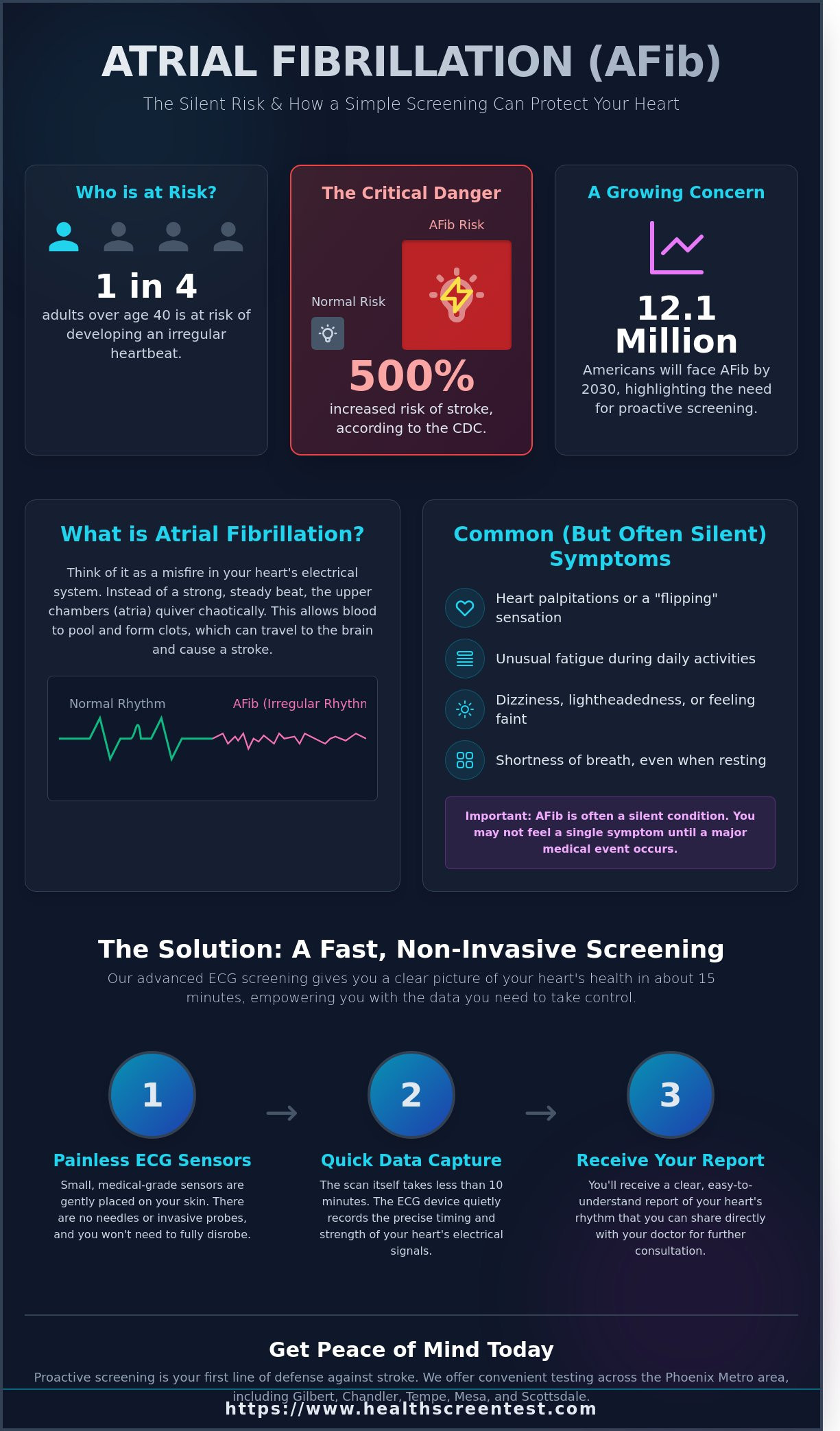
Did you know that 1 in 4 adults over the age of 40 is at risk of developing an irregular heartbeat? According to data from the CDC, nearly 12.1 million Americans will face this condition by 2030, yet many symptoms go unnoticed until a crisis occurs. If you’ve ever felt a sudden flutter in your chest or worried about the looming threat of a stroke, you aren’t alone. It’s completely natural to feel frustrated by long hospital wait times in Phoenix or Peoria when all you want is a professional atrial fibrillation screening to get a simple answer about your heart health. ❤️
We believe that your health data should be accessible and stress-free. That’s why we’ve streamlined the diagnostic process across the Phoenix Metro area, including local clinics in Gilbert, Chandler, Tempe, and Mesa. You’ll discover how a non-invasive, 15 minute check can provide the peace of mind your family deserves. This guide walks you through our seamless approach, from identifying subtle rhythm changes to receiving a clear report you can hand directly to your GP. Let’s take control of your wellness together. 🩺✨
Key Takeaways
- Understand the life-saving importance of detecting irregular heart rhythms early to significantly reduce your stroke risk by up to 500%. 🌵
- Learn how a simple, non-invasive atrial fibrillation screening uses advanced ECG technology to provide a clear and accurate picture of your heart’s health. 💓
- Identify the key risk factors-like age and blood pressure-that make proactive monitoring essential for residents across the Phoenix Metro area. 🧐
- Discover practical tips for your screening day, from choosing the right attire to finding a convenient mobile testing site in your neighborhood. 📋
- Find out how to access professional, discreet diagnostic services that empower you to take control of your wellness with clinical certainty. 🏥
Understanding Atrial Fibrillation Screening in the Phoenix Metro Area 🌵
Your heart rhythm is something you likely take for granted until it feels a bit off. In the Phoenix Metro area, thousands of residents live with a condition called Atrial Fibrillation, or AFib, often without even realizing it. This common heart rhythm disorder affects between 2.7 million and 6.1 million people in the United States according to data from the CDC. While it might sound like just a minor flutter, the stakes are incredibly high. The CDC reports that having AFib increases your risk of suffering a stroke by 500%. That is a staggering number that underscores why proactive health management is so vital for our community.
If you’re living in Mesa or Gilbert, you might be busy enjoying local parks or golf courses, unaware that AFib is frequently a silent condition. Many people don’t feel a single symptom until a major medical event occurs. This is exactly where atrial fibrillation screening becomes your most powerful tool. It’s about catching an electrical misfire before it leads to a crisis. In cities like Chandler and Tempe, the heat isn’t the only thing to watch out for. Because symptoms can be intermittent, they’re often dismissed as simple aging or dehydration. You might feel a brief flutter while walking through a local trail and think nothing of it. However, these brief moments are windows into your heart’s electrical health.
What is AFib and Why Does it Matter?
Think of your heart as a precisely timed engine. In a healthy heart, the electrical signals flow smoothly to keep the beat steady. AFib acts like a misfire in that electrical system. Instead of a strong, regular contraction, the upper chambers of the heart quiver. This chaotic movement allows blood to pool, which can lead to the formation of dangerous blood clots. For a comprehensive overview of atrial fibrillation, it’s helpful to understand that these clots can travel to the brain, causing a stroke. By choosing to undergo atrial fibrillation screening, you’re opting for a proactive lifestyle choice rather than a reactive medical necessity.
You might notice these signs, or you might feel nothing at all:
- 💓 Heart palpitations or a flipping sensation in the chest
- 😫 Unusual fatigue during daily activities or exercise
- 🌬️ Shortness of breath, even when you are resting
- 😵 Dizziness, lightheadedness, or feeling faint
The Role of Preventive Screening in Arizona
For the active 40+ community in Scottsdale and Sun City West, staying ahead of heart health is part of maintaining a high quality of life. You’ve worked hard to enjoy your retirement or peak career years, and you shouldn’t let a hidden heart rhythm issue slow you down. Local health events and dedicated clinics in the Valley now make these tests more accessible than ever. You don’t have to wait for a hospital visit to get answers. At Health Screen Test, we believe that data-driven wellness should be a routine, stress-free part of your life. You can learn more about our commitment to your health and peace of mind on our about-us page. Early detection ensures that you stay in control of your journey, providing the professional warmth and clinical certainty you deserve.
How AFib Screenings Detect Irregular Rhythms 💓
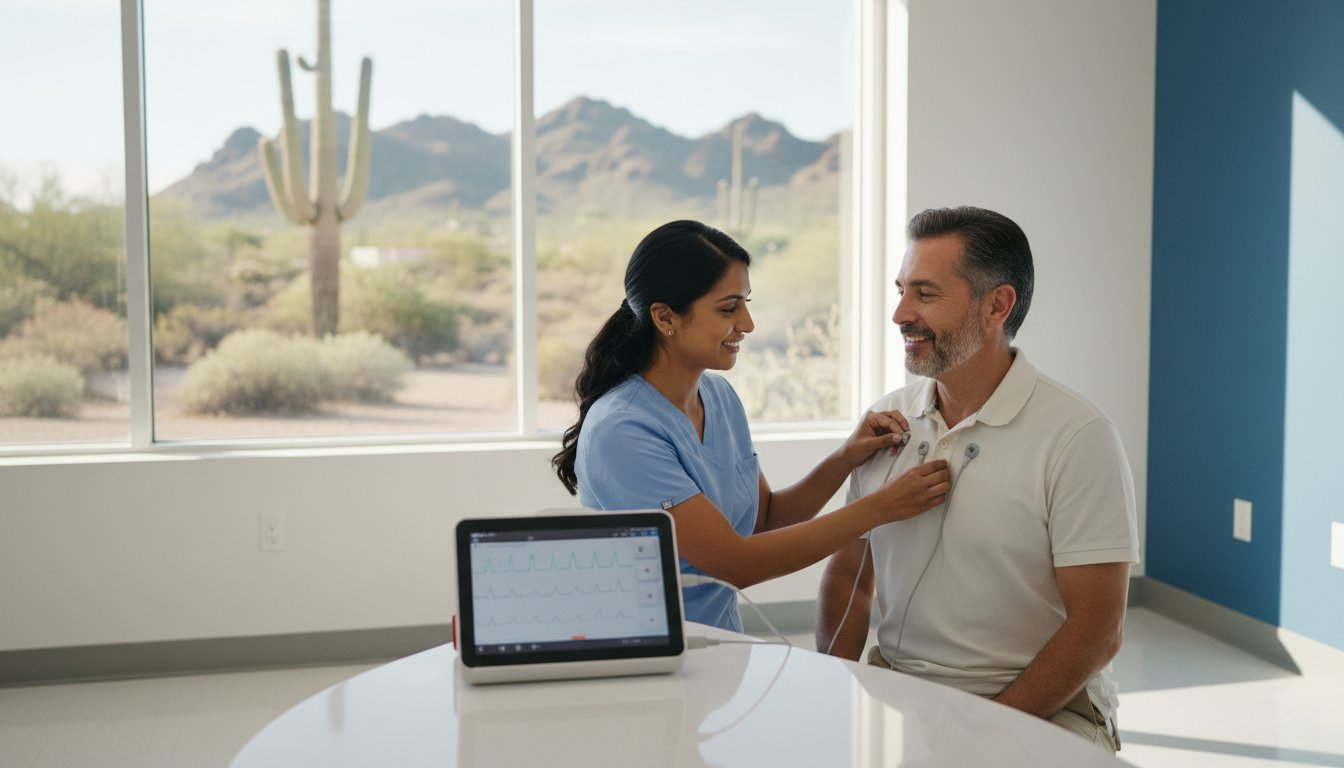
When you walk into a clinic for an atrial fibrillation screening, the process is designed to be as stress-free as a routine blood pressure check. We rely on the Electrocardiogram, or ECG, as our primary diagnostic tool. This clinical device doesn’t use needles or invasive probes. Instead, it uses small, medical-grade sensors placed gently on your skin to track the electrical activity of your heart. These sensors act like high-fidelity microphones, capturing the precise timing and strength of the electrical signals that make your heart beat.
The entire experience is built around your comfort. You won’t need to fully disrobe, and the actual data collection takes less than 10 minutes. It’s a quick, quiet process that fits easily into a busy morning in Tempe or a lunch break in Chandler. Once the data is captured, it isn’t just processed by a computer. Every result is reviewed by board-certified physicians to ensure clinical accuracy. Understanding how AFib screenings detect irregular rhythms is the first step toward replacing health anxiety with factual certainty.
ECG vs. Wearable Tech (Smartwatches)
Many of our neighbors in Scottsdale and Gilbert use smartwatches to track their steps and heart rate. While these consumer devices are helpful for daily wellness, they lack the diagnostic depth of a clinical 12-lead ECG. A smartwatch typically uses a single-lead system, which provides a limited view of the heart’s electrical landscape. In contrast, a professional screening captures data from multiple angles, allowing physicians to see the whole picture. “While wearables are great for tracking, a clinical ECG remains the gold standard for identifying silent arrhythmias.” If you’ve received an alert on your watch, booking a professional Health Screen Test is the best way to verify those findings with medical-grade precision.
What the Screening Specifically Measures
An effective screening looks at more than just how fast your heart is beating. We distinguish between your heart rate, which is the number of beats per minute, and your heart rhythm, which is the actual pattern of those beats. A healthy heart follows a steady, predictable “lub-dub” rhythm. During an atrial fibrillation screening, we look for chaotic or irregular patterns that suggest the upper chambers of the heart are quivering instead of pumping effectively.
- Heart Rate: Measures the speed of your pulse, ensuring it stays within the healthy 60 to 100 beats per minute range.
- Heart Rhythm: Analyzes the electrical peaks and valleys to identify “A-flutter” (Atrial Flutter), a condition where the heart beats fast but in a regular, “sawtooth” pattern.
- Signal Clarity: Identifies “silent” AFib, which is an irregular rhythm that occurs without any physical symptoms like palpitations or shortness of breath.
By identifying these patterns early, you gain the power to manage your health before complications arise. Whether you are in Mesa, Phoenix, or Sun City West, accessing this data provides a clear roadmap for your long-term wellness. Our goal is to make these clinical insights accessible to everyone over 40, ensuring that a proactive lifestyle is supported by the best diagnostic data available today.
Who Should Consider Atrial Fibrillation Screening in Mesa and Chandler? 🧐
Deciding whether to book a medical test often feels like a balancing act between caution and necessity. You might hear about the “insufficient evidence” debate regarding universal testing for everyone. While some medical panels debate the cost-effectiveness of screening every single adult, the conversation changes entirely when we look at high-risk groups in the East Valley. If you fall into specific categories, waiting for a major symptom like a stroke or heart failure isn’t just risky; it’s avoidable. Clinical data suggests that 1 in 4 adults over the age of 40 will develop an irregular heartbeat at some point. For residents in Mesa and Chandler, an atrial fibrillation screening acts as an early warning system that catches issues before they escalate into emergencies.
Our unique desert environment adds another layer to heart health that folks in cooler climates don’t have to worry about. We call it the “Arizona Factor.” When the mercury rises above 110 degrees in Phoenix or Scottsdale, your cardiovascular system experiences significant physiological stress. Dehydration leads to electrolyte imbalances, specifically a drop in magnesium and potassium. These imbalances are notorious for triggering heart palpitations. If you’ve felt your heart racing after a long afternoon in the sun, it’s vital to know if that’s a simple heat response or a sign of an underlying arrhythmia.
Risk Factors You Can and Cannot Control
Understanding your risk profile is the first step toward taking control. There are certain factors you simply can’t change. Age is the most prominent; the likelihood of developing AFib increases significantly once you pass 65. Genetics also play a role. If a parent or sibling has been diagnosed, your baseline risk is higher. Biological sex is another factor, as men are statistically more likely to develop the condition, though women often face more severe complications if it goes untreated. The NIH reports that nearly 91% of AFib cases involve at least one modifiable risk factor. This is where your power lies. Managing your weight, staying active in communities like Sun City West or Gilbert, and keeping your blood pressure consistently below 120/80 can drastically change your health trajectory.
When “Peace of Mind” Becomes a Priority
Living with the “what if” can be emotionally draining for many residents in Tempe and Buckeye. The anxiety of feeling a skip in your pulse while resting can affect your quality of life. For our clients, the primary benefit of an atrial fibrillation screening is the professional warmth and certainty it provides. A negative result is often the best “health insurance” you can have, allowing you to enjoy your retirement or career without a cloud of worry hanging over you. If you manage conditions like type 2 diabetes or sleep apnea, being proactive is essential. These conditions are closely linked to heart rhythm disturbances, making regular checks a vital part of a modern, data-driven wellness plan.
Proactive health isn’t about being reactive to pain; it’s about staying ahead of the curve. Whether you’re a marathon runner in Paradise Valley or someone enjoying a quiet life in San Tan Valley, knowing your numbers gives you the freedom to live fully. We believe that health information should be accessible, discreet, and, above all, actionable. Don’t let a hidden condition dictate your future when a simple, non-invasive test can provide the answers you need today.
Preparing for Your Heart Screening in Scottsdale or Tempe 📋
Taking a proactive step toward your cardiovascular health should be a stress-free experience. Preparing for your atrial fibrillation screening doesn’t require complex medical knowledge or hours of fasting. By following a few simple guidelines, you can ensure that your results are accurate and that your visit to one of our Phoenix Metro locations is as efficient as possible. Our goal is to provide you with clinical clarity while respecting your busy schedule.
- Step 1: Locate a convenient mobile screening site. We host events across the entire Valley, from Sun City West to San Tan Valley. You can find a local community center or church hall in your specific neighborhood, whether you live in Buckeye or Paradise Valley. This eliminates the need to commute to a large, intimidating hospital complex.
- Step 2: Wear comfortable, loose-fitting clothing. We highly recommend a two-piece outfit consisting of a separate top and bottom. This allows our technicians to easily place screening sensors on your wrists and ankles without requiring you to change into a clinical gown.
- Step 3: Avoid heavy caffeine or large meals. Please skip your morning espresso or a heavy breakfast at least two hours before your appointment. Caffeine is a stimulant that can temporarily elevate your heart rate or cause minor palpitations, which might complicate the interpretation of your heart rhythm data.
- Step 4: Bring a list of current medications. Certain prescriptions, such as beta-blockers or calcium channel blockers, are designed to regulate heart rate. Providing this list helps our team understand your baseline health and ensures your report is as precise as possible for your follow-up care.
What to Expect on the Day of Your Test
When you arrive at a mobile screening event in Mesa or Gilbert, you will notice a calm, non-clinical atmosphere. There are no cold metal tables or sterile hospital smells. Instead, you’ll be greeted by a professional team dedicated to your comfort. The process is remarkably fast; most participants are in and out in under 60 minutes. You will receive a clear, color-coded report that outlines your findings. This document is designed for you to take directly to your primary care physician to discuss your long-term wellness strategy.
No Insurance? No Problem.
We believe that atrial fibrillation screening should be accessible to everyone, regardless of their current insurance status. These screenings do not require a doctor’s order, which puts the power of health management directly in your hands. We utilize a transparent pricing model, meaning you pay a flat fee upfront with zero hidden hospital facility charges or surprise bills. This approach makes high-end diagnostics a routine part of a proactive lifestyle. You can learn more about the comprehensive heart health screenings offered by Health Screen Test and how we empower individuals to take charge of their health.
Your heart health shouldn’t be a mystery that you only solve during an emergency. By choosing a private screening, you are opting for a discreet and accurate way to monitor your vitals. It is a seamless way to gain peace of mind and stay active for your family in Chandler, Glendale, or Queen Creek. If you are ready to take the next step, you can schedule your heart health evaluation today and join the thousands of Arizonans prioritizing their long-term wellness.
Accessing Affordable AFib Screening Near You with Health Screen Test 🏥
Health Screen Test acts as your local gateway to sophisticated heart diagnostics right here in Arizona. We know that the traditional healthcare system can feel slow, expensive, or even intimidating. That’s why we’ve streamlined the process. We bring professional atrial fibrillation screening directly to your neighborhood. By coordinating with established, CLIA-certified laboratories and advanced mobile units, we ensure you receive clinical-grade data without the typical hospital wait times or high costs. Our events in San Tan Valley, Queen Creek, and Sun City West provide accessible options for those who prioritize their long-term wellness. According to data from the Centers for Disease Control and Prevention (CDC), early detection of AFib is a critical step in preventing life-altering strokes. We’re here to help you secure those odds with speed and precision.
Our service model is built on the belief that health data should be both accessible and actionable. We don’t just provide a test; we provide a bridge to better health outcomes. By utilizing the same high-end technology found in major medical centers, we offer a diagnostic experience that is both discreet and reliable. Since we began serving the Arizona community, we’ve helped thousands of residents identify hidden risks before they become emergencies. This proactive approach turns health management into a routine part of a well-lived life rather than a reactive response to a crisis.
Our Commitment to the Arizona Community
Our mission extends across the entire Valley. Whether you live in Glendale or Paradise Valley, we bring essential health services to your doorstep. We believe that distance should never be a barrier to high-quality care. We’ve expanded our reach to include Avondale, Goodyear, and Buckeye, ensuring that no resident is more than a short drive away from professional screening. One of our recent participants, a 58-year-old resident named Sarah from Tempe, shared her story with us. She’d been feeling occasional heart flutters for months but kept putting off a doctor’s visit due to the hassle of scheduling. Our mobile unit provided her with results in minutes, which she then took to her cardiologist. If you have specific questions about our upcoming events or need help choosing a test, feel free to Contact Us anytime. We’re here to guide you through every step of the process.
Next Steps After Your Screening
Once you receive your results, you’ll have a clear, data-driven picture of your heart’s electrical rhythm. If your report shows a normal sinus rhythm, it provides that vital peace of mind we all crave. If a follow-up is recommended, you’ll have the precise documentation required to start an informed conversation with your primary care physician or specialist. Taking a proactive approach doesn’t stop at your heart rhythm. We often see that cardiovascular health is a holistic journey. Managing your atrial fibrillation screening results effectively often involves looking at other vital biomarkers. For this reason, we recommend exploring our resources on comprehensive cholesterol management. Keeping your arteries clear is just as important as keeping your heart rhythm steady. This integrated view of health ensures you’re protecting your body from every angle.
Taking control of your health is the greatest gift you can give to your family. It ensures you stay present for the birthdays, graduations, and quiet moments that matter most. We invite you to join the growing number of Arizonans who have chosen a path of personal empowerment through data. Don’t wait for symptoms to dictate your future when you can take charge today.
Take Control of Your Heart Health Today
Your heart doesn’t wait for a convenient time to show signs of trouble, so taking a proactive step is the smartest move you can make for your future. Identifying irregular rhythms early through an atrial fibrillation screening helps prevent severe complications like stroke, which the CDC reports affects nearly 800,000 people in the US every year. We’ve made this process seamless for our community members across the Phoenix metro area. You don’t need a doctor’s order or insurance to get started today. 🌵💓
Health Screen Test is already trusted by thousands of Arizona residents over 40 who want clear answers without the clinical headache. With access to over 15,000 convenient mobile screening locations nationwide, finding a site in Gilbert, Chandler, or Mesa is simple. You’ll receive professional, accurate data that empowers you to manage your wellness with confidence. Don’t leave your cardiovascular health to chance when the tools for certainty are right in your neighborhood. 🏥✨
Secure Your Peace of Mind: Book a Heart Screening Near You
We’re here to help you stay ahead of the curve and keep your heart beating strong for years to come. Your future self will thank you for being so proactive today.
Frequently Asked Questions
Is atrial fibrillation screening painful or invasive?
Atrial fibrillation screening is completely painless and non-invasive, involving no needles or uncomfortable procedures. We use clinical-grade sensors placed on your skin to record the electrical signals of your heart. You won’t feel anything during the process, which usually takes about 15 minutes from start to finish. It’s a simple, stress-free way to gain peace of mind about your cardiovascular health. 🕊️
How much does an AFib screening cost in Phoenix without insurance?
An AFib screening in the Phoenix metro area typically costs between $150 and $350 when paying out-of-pocket. We provide transparent, upfront pricing so you don’t have to worry about hidden fees or surprise bills later. This flat rate covers the technical assessment and a detailed report of your heart rhythm. Investing in this proactive check now can help you avoid the much higher costs associated with emergency cardiac events. 💳
Can I get an AFib screening in Gilbert without a doctor’s referral?
You don’t need a doctor’s referral to book an atrial fibrillation screening at our Gilbert or Tempe locations. We believe that you should have direct access to your own health data without unnecessary hurdles. By allowing you to self-schedule, we save you the time and expense of an initial office visit. You’re empowered to take control of your heart health on your own terms. 📍
What happens if the screening detects an irregular heartbeat?
If we detect an irregular rhythm, we’ll provide you with a comprehensive report to share with your primary care physician or cardiologist. The CDC reports that roughly 12.1 million Americans will have AFib by 2030, so finding it early is a proactive step in modern wellness. We’ll guide you through the results with professional warmth, ensuring you have the facts needed for a productive follow-up. 📋
How long does it take to get my AFib screening results?
You’ll receive your screening results through a secure digital portal within 24 to 48 hours of your appointment. We prioritize a fast turnaround because we know that waiting for health information can be a bit nerve-wracking. Our streamlined process ensures your data is processed accurately and delivered privately. This allows you to review your heart’s performance and plan your next steps quickly. ⏱️
Are these screenings as accurate as a hospital EKG?
Our screenings use high-fidelity technology that offers clinical-grade accuracy for detecting rhythm abnormalities. While a hospital’s 12-lead EKG remains the diagnostic gold standard, research from the NIH indicates that modern screening devices have a sensitivity rate of over 94% for identifying AFib. This makes our service a highly reliable tool for early detection. It’s a sophisticated way to monitor your heart without the clinical coldness of a hospital setting. ✅
Does a normal AFib screening mean my heart is 100% healthy?
A normal result means no irregularities were found during your session, but it doesn’t guarantee your heart is 100% healthy forever. Since AFib can be paroxysmal, or intermittent, a single atrial fibrillation screening only captures your rhythm at that specific moment. We recommend regular monitoring, especially for residents over age 40 in cities like Scottsdale and Mesa. Consistency is the key to maintaining long-term heart health and catching changes early. 🔍
Can I eat or drink coffee before my heart screening appointment?
You can eat normally before your visit, but you should avoid caffeine for at least 2 hours before your appointment. Coffee, tea, and energy drinks can temporarily increase your heart rate or cause palpitations, which might mask your natural rhythm. Staying hydrated with water is perfectly fine and actually helps our sensors get a clearer reading. Following these simple instructions ensures your results are as precise as possible. ☕