


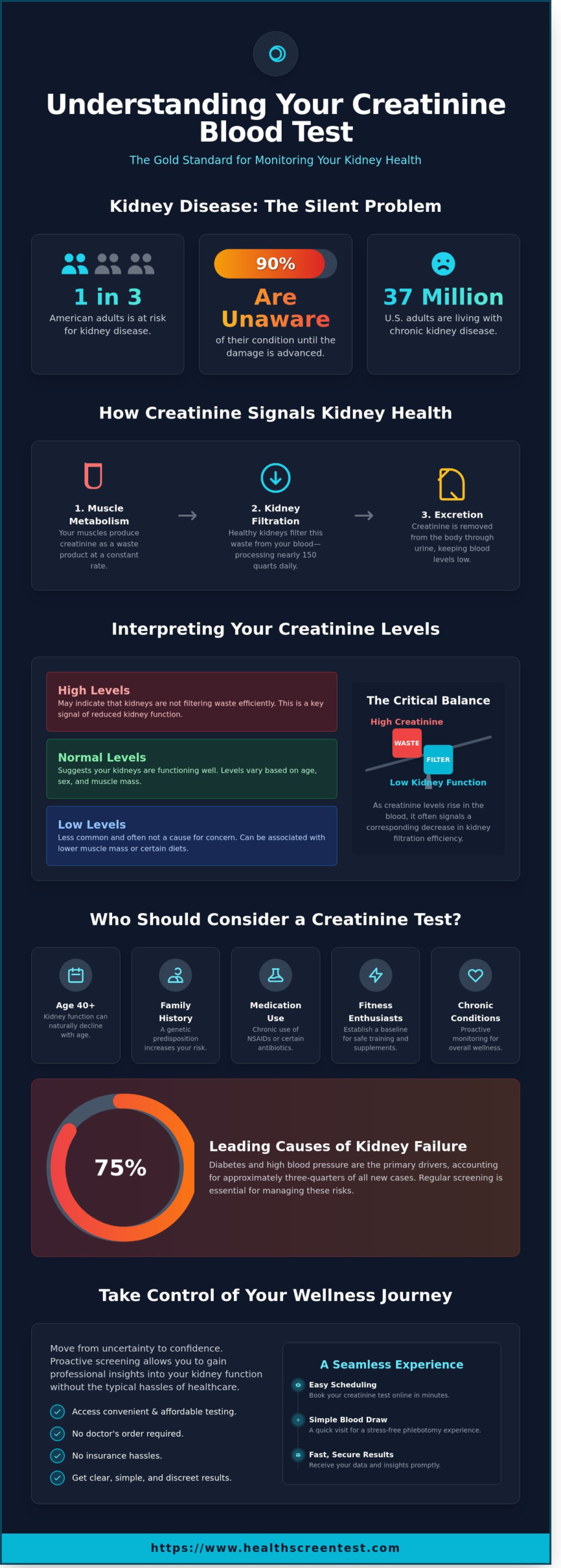
According to the National Kidney Foundation, 1 in 3 American adults is at risk for kidney disease, yet most people don’t realize there’s an issue until the damage is advanced. It’s completely natural to feel a sense of anxiety when you’re trying to decode medical jargon or searching for a creatinine blood test mesa while waiting weeks for a doctor to clear their schedule. You want clear answers about your health, and you shouldn’t have to jump through hoops to get them.
We’re here to help you take control with simple, clinical insights that make sense. You’ll discover how this essential screening provides a precise look at your kidney function without the need for a traditional doctor’s order. This guide breaks down exactly what your levels mean, how the screening process works in 2026, and how you can access high quality testing right here in the East Valley. We’ll show you how to move from uncertainty to total confidence in your wellness journey.
Key Takeaways
- Understand why creatinine is considered the “gold standard” biomarker for measuring how effectively your kidneys filter metabolic waste from your bloodstream.
- Learn how to accurately interpret your results using adult reference ranges to identify what specific levels indicate about your overall renal health.
- Discover simple, stress-free preparation steps to ensure a seamless phlebotomy experience and the most accurate data for your records.
- Find out how to access a convenient and affordable creatinine blood test mesa without the need for a doctor’s order or insurance hassles.
- Take control of your long-term wellness by using proactive, discreet screenings to gain professional insights into your kidney function and health status.
What is a Creatinine Blood Test and Why is it Essential?
Your kidneys serve as a sophisticated filtration system, working 24 hours a day to remove waste and excess fluid from your bloodstream. One of the most critical markers they filter is creatinine, a chemical waste molecule generated from muscle metabolism. When you schedule a creatinine blood test mesa, you are essentially checking the efficiency of this filtration process. Medical professionals consider this test the gold standard for renal assessment because it provides a clear, data-driven snapshot of how well your kidneys are performing their primary job. According to the CDC, approximately 37 million US adults live with chronic kidney disease, yet 90% are unaware of their condition. This makes routine screening a vital step in maintaining long-term wellness.
Most patients encounter this measurement as part of a Comprehensive Metabolic Panel (CMP). This panel includes several biomarkers that provide a holistic view of your health. For individuals over the age of 40, monitoring these levels annually is a proactive way to catch subtle changes before they become significant issues. It’s a simple blood draw that offers deep insights into your internal health landscape, allowing you to take control of your biological data with confidence and clarity.
To better understand how your muscle mass and lifestyle choices interact with these laboratory results, watch this helpful video:
The Link Between Muscle and Kidneys
Your body produces creatinine at a remarkably constant rate based on your muscle mass. Understanding What is Creatinine? helps clarify why levels stay stable unless kidney function changes. Healthy kidneys clear this waste from the blood and move it into the urine for excretion. However, certain factors like a high-protein diet or intense resistance training can temporarily influence your baseline. If you’ve recently completed a high-intensity workout in Mesa, your results might show a slight elevation that isn’t necessarily cause for alarm, but rather a reflection of your active lifestyle.
Who Should Consider a Creatinine Test in Mesa?
Proactive screening is an empowering lifestyle choice, especially for those with specific health profiles. The NIH reports that diabetes and high blood pressure are the leading causes of kidney failure, accounting for about 75% of new cases. If you manage these conditions, or have a family history of renal issues, regular testing is essential for your peace of mind. You should also consider a creatinine blood test mesa if you regularly take medications like NSAIDs or specific antibiotics that can tax the kidneys over time. Identifying risks early through a Health Screen Test allows for seamless adjustments to your wellness plan.
- Individuals aged 40 and older: Natural aging processes can affect filtration rates.
- People with Type 1 or Type 2 Diabetes: High blood sugar can damage the delicate vessels in the kidneys.
- Those with Hypertension: High blood pressure is a primary driver of renal stress.
- Frequent users of over-the-counter pain relievers: Chronic use of ibuprofen or naproxen requires monitoring.
- Fitness enthusiasts: To establish a baseline for safe supplementation and training.
How Your Kidneys Use Creatinine to Signal Health
Your kidneys serve as the body’s high-performance filtration plant. They work around the clock to process nearly 150 quarts of blood daily. During this process, they remove creatinine, which is a waste product generated by your muscles during normal activity. If your kidneys are healthy, they filter this waste out through your urine efficiently. When levels begin to rise in your bloodstream, it’s often a clear signal that the filtration rate is slowing down.
Getting a creatinine blood test mesa is a proactive way to monitor this delicate balance. It’s a simple blood draw, but the results provide deep insights into your internal health. It’s vital to remember that creatinine levels can be influenced by your physical build. A very muscular athlete will naturally produce more waste than a sedentary person. This is why we look at the data through a wider lens to ensure accuracy for your specific body type. By checking the Creatinine Test results against your age and weight, we get a much clearer picture of your renal health.
Many kidney issues are “silent” because they don’t cause pain or noticeable symptoms in the early stages. Research from the National Kidney Foundation shows that about 33% of American adults are at risk for kidney disease, yet most don’t realize it until the condition is advanced. Regular screening is the only way to catch these issues before they progress, allowing for lifestyle changes that can protect your organs for years to come.
Understanding Glomerular Filtration Rate (GFR)
GFR is a calculation that tells us exactly how many milliliters of blood your kidneys filter per minute. It’s often more descriptive than the raw creatinine number alone. The NIH categorizes kidney health based on this rate; a GFR above 90 is healthy, while a score below 60 for three months or more suggests your kidneys aren’t working at full capacity. This metric allows us to provide you with a definitive health status rather than just a single data point.
Creatinine vs. Cystatin C
For some patients, we might suggest a Cystatin C test alongside a standard screening. Cystatin C is a protein that doesn’t fluctuate based on your muscle mass or what you ate for dinner. This makes it an incredibly accurate biomarker for the elderly or those with chronic illnesses who need precise monitoring. Choosing the right test ensures you get the most reliable data for your lifestyle. If you’re ready to take charge of your health, you can view our available kidney health panels to find the best fit for your needs.
Interpreting Your Results: What High or Low Levels Mean
When you receive your results from a creatinine blood test mesa lab, the first thing you’ll see is a numerical value followed by a reference range. For adult men, this typical range falls between 0.7 and 1.3 mg/dL. For adult women, it usually sits between 0.6 and 1.1 mg/dL. It’s vital to remember that these numbers aren’t universal laws. A 2023 report from the American Association for Clinical Chemistry indicates that reference intervals can vary by as much as 15% between different testing facilities based on the specific equipment used. If your result is 1.2 and the lab cutoff is 1.1, don’t panic. A single high reading doesn’t automatically confirm kidney disease. To understand what a creatinine test measures, we have to look at how your body processes waste in real time. Factors like a temporary stomach bug or simply not drinking enough water before your appointment can cause a spike that isn’t representative of your long-term health.
Common Causes of Elevated Creatinine
Clinical issues like chronic kidney disease (CKD) or kidney stones are the primary concerns when levels rise. About 1 in 7 U.S. adults live with CKD, according to the CDC. However, lifestyle choices often play a significant role in your data. If you ate an 8-ounce steak the night before your test or completed a 45-minute high-intensity workout, your levels might look elevated. Dehydration is another common culprit. When your body lacks fluids, your kidneys can’t flush out waste as efficiently. Consider these common factors:
- Clinical: Kidney infections, urinary tract obstructions, or reduced blood flow to the kidneys.
- Non-Clinical: High protein intake, creatine supplements, or intense physical exertion within 24 hours of the test.
- Medications: Certain antibiotics or stomach acid blockers can temporarily interfere with how kidneys release creatinine.
If your levels stay elevated after you hydrate and rest for 48 hours, scheduling a follow-up creatinine blood test mesa helps confirm if the issue is persistent or just a temporary fluctuation.
What if Your Levels are Low?
Seeing a “low” flag on your report is rarely a cause for immediate alarm. Creatinine is a byproduct of muscle metabolism, so if you have lower muscle mass, your levels will naturally be lower. This is particularly common for seniors. Research from the National Institutes of Health (NIH) shows that muscle mass can decline by 3% to 8% per decade after age 30, a process known as sarcopenia. Nutrition also plays a part; those on low-protein or vegan diets may see lower numbers. We view low levels as a prompt to evaluate your protein intake or strength training routine rather than a sign of organ failure. It’s about looking at the whole person, not just the number on the page. Just as an out-of-range flag on a creatinine panel can feel alarming, understanding what an elevated marker truly means is equally important for other biomarkers — for example, learning what your results indicate through an alkaline phosphatase test Gilbert residents can access directly provides the same kind of clarity for bone and liver health.
Preparing for Your Test: A Seamless Experience
Taking control of your kidney health shouldn’t be a stressful or confusing process. When you schedule your creatinine blood test mesa, the experience is designed to be efficient, private, and clinical. Most patients spend less than 15 minutes total at the collection site, making it easy to fit into a busy schedule in the East Valley. By following a few simple steps, you ensure your results are as accurate as possible, giving you a clear picture of your renal function.
Fasting and Activity Requirements
While a standalone creatinine test often doesn’t require you to stop eating, many people choose to bundle it with a Comprehensive Metabolic Panel (CMP) for a fuller health overview. If you’re doing a CMP, you’ll need to fast for 8 to 12 hours. Research from the National Institutes of Health (NIH) indicates that intense physical exertion can temporarily spike creatinine levels due to muscle breakdown. We recommend avoiding heavy weightlifting or strenuous cardio for at least 24 hours before your draw. You should drink plenty of water, though. Staying well-hydrated makes your veins easier to find and helps the phlebotomist complete the draw quickly and comfortably.
What to Expect at the Mesa Lab Location
Our partnership with established diagnostic leaders like Quest Diagnostics and LabCorp ensures you receive professional care at convenient locations throughout Mesa and surrounding areas like Gilbert or Tempe. You’ll check in quickly using your digital lab requisition. The actual blood draw usually takes less than five minutes. If you feel anxious about needles, don’t hesitate to tell the technician. These professionals perform dozens of draws daily and use techniques to minimize discomfort. Because we use a direct-to-consumer model, your privacy is protected. Your data stays between you and the lab, bypassing the often-clunky traditional insurance systems.
You won’t be left wondering about your status for long. Most results are processed and uploaded to your secure private portal within 24 to 48 hours. This rapid turnaround allows you to address any concerns with factual certainty. Taking a proactive approach to your wellness is the best way to ensure long-term vitality as you age.
Checking your biomarkers regularly is a hallmark of modern health management. It moves you away from reactive medicine and toward a lifestyle of informed prevention. Whether you are monitoring a known condition or simply establishing a baseline for your 40s and 50s, a creatinine blood test mesa provides the data you need to stay in command of your journey.
Taking Control: Affordable Kidney Screenings in Mesa
Residents in Mesa, Gilbert, and Chandler often face long wait times for specialist referrals and the stress of navigating insurance requirements. Health Screen Test removes these barriers by serving as your professional guide to direct-to-consumer diagnostics. You don’t need a doctor’s order or a complex insurance claim to prioritize your renal health. As of 2023, the Centers for Disease Control and Prevention (CDC) reports that 1 in 7 US adults, approximately 37 million people, are living with chronic kidney disease, yet many don’t realize it until the later stages. By opting for a creatinine blood test mesa, you’re choosing a path of proactive wellness rather than reactive treatment.
Our process is designed to be efficient and discreet. We understand that your time is valuable, which is why we’ve streamlined the journey from booking to results. Whether you’re a long-time resident of Tempe or recently moved to Queen Creek, accessing high-quality health data is now a standard part of a well-lived life. We provide the tools you need to understand your body’s internal chemistry without the typical clinical friction found in traditional healthcare settings. Just as many residents seek clarity about elevated liver enzymes Scottsdale testing provides, kidney function monitoring offers the same peace of mind for your renal health.
Why Choose Health Screen Test?
We combine clinical precision with a supportive, human-centered approach to preventive care. Our partnership with over 3,000 permanent and mobile lab locations across Arizona and the United States ensures that professional phlebotomy services are always within reach. You won’t have to drive across the valley to find a reliable facility. We focus on essential biomarkers and pathology to deliver accurate insights that you can actually use. Our model is built on the belief that everyone deserves transparent access to their own medical information. We offer the same high-end diagnostic technology used by major hospitals, but we deliver it with the speed and privacy of a premium private service.
Your Path to Peace of Mind Starts Here
It’s time to stop guessing about your kidney function and start knowing your numbers. Knowledge is the foundation of health optimization, especially for adults over 40 who want to maintain an active lifestyle in the East Valley. Scheduling your creatinine blood test mesa is a simple, three-step process that puts you back in the driver’s seat. Our Mens and Womens Comprehensive Packages are specifically curated to look at the big picture, ensuring no vital marker is overlooked. You’ll receive clear, fast results that allow you to make informed decisions about your diet, hydration, and overall longevity.
Taking charge of your health shouldn’t feel like a daunting medical event; it’s a routine, empowering choice that provides lasting certainty for you and your family.
Secure Your Kidney Health with Proactive Screening
Your kidneys filter approximately 200 quarts of fluid every single day to maintain your body’s internal balance. Monitoring your renal function through a creatinine blood test mesa is the most effective way to identify potential issues before they become serious concerns. The CDC notes that 90% of adults with chronic kidney disease are unaware of their condition, which makes regular screening a vital part of your wellness routine. By checking your levels now, you’ll gain a clear understanding of your Glomerular Filtration Rate and overall metabolic efficiency.
HealthScreen simplifies this process by offering clinical-grade testing without the requirement of a doctor’s visit or a long wait in a cold clinic. We provide access to over 7,000 certified lab locations across the country, including several convenient sites throughout Mesa. Your secure, private results are delivered to your online portal within 24 to 48 hours, giving you the data you need to make informed decisions about your future.
Order Your Comprehensive Health Screening Today and take the first step toward lasting peace of mind. It’s time to prioritize your health with the professional care you deserve.
Frequently Asked Questions
Do I need a doctor’s order for a creatinine blood test in Mesa?
You don’t need a physician’s referral to schedule a creatinine blood test in Mesa because Arizona law allows for direct access testing. This legislative change, specifically Arizona House Bill 2045, empowers you to take control of your kidney health without a prior doctor visit. HealthScreen provides a seamless way to book your appointment and receive clinical-grade results directly through our secure portal for total peace of mind.
How much does a creatinine test cost without insurance?
A standalone creatinine test typically costs between $30 and $65 when paying out-of-pocket in Mesa. Prices vary based on the laboratory and whether the test is part of a larger metabolic panel. At HealthScreen, we believe in transparent pricing to help you manage your wellness budget effectively. Our 2026 pricing models ensure that professional diagnostics remain accessible to every resident in the East Valley without hidden fees.
Can dehydration cause high creatinine levels in my blood test?
Yes, dehydration can lead to elevated creatinine levels because a lack of fluids reduces blood flow to your kidneys. According to the National Institutes of Health, even a 2 percent drop in body water can impact renal function markers on a lab report. If your levels appear high, your clinician might suggest retesting after you’ve properly hydrated to ensure the data reflects your true kidney health rather than temporary fluid loss.
How long does it take to get creatinine test results back?
Most patients receive their creatinine blood test mesa results within 24 to 48 hours after their phlebotomy appointment. Our modern pathology labs prioritize speed and accuracy to reduce the anxiety of waiting for important health data. Once the lab completes the analysis, you’ll receive a secure notification to view your comprehensive report online, allowing you to discuss the findings with your healthcare provider or specialist immediately.
Should I fast before my creatinine blood test?
You generally don’t need to fast for a creatinine test, though you should avoid eating cooked meat for 24 hours before the blood draw. Research from the Mayo Clinic indicates that consuming significant amounts of protein can temporarily spike creatinine levels in your bloodstream. If your creatinine test is bundled with a glucose or cholesterol panel, you’ll likely need to fast for 8 to 12 hours for accurate results.
What is the difference between a creatinine blood test and a urine test?
A blood test measures the current concentration of creatinine in your bloodstream, while a urine test evaluates how efficiently your kidneys filter that waste over a specific period. Doctors often use the blood test to calculate your Glomerular Filtration Rate, which is a primary indicator of kidney stage health. Combining both tests provides a more detailed picture of renal function than relying on a single biomarker alone during your screening.
Is a creatinine test included in a standard wellness panel?
Yes, a creatinine test is a core component of the Comprehensive Metabolic Panel and the Basic Metabolic Panel. These panels are standard in annual physicals and wellness screenings across Maricopa County. Approximately 90 percent of routine wellness blood draws include creatinine to monitor kidney function alongside electrolytes and blood sugar levels, providing a vital foundation for proactive health management and early detection of potential issues.
What should I do if my creatinine levels are outside the normal range?
If your results fall outside the reference range, you should schedule a follow-up with your primary care physician to discuss the findings. Abnormal levels don’t always indicate kidney disease; factors like high-intensity exercise or specific medications can influence the data. Your doctor will likely review your medical history and may order a repeat test or a more specific diagnostic, like a cystatin C test, to confirm the initial results.

Article by
Alexander Aquino, RN
With over 35 years of dedicated service within the healthcare industry, I've witnessed firsthand the profound difference early detection can make in saving lives. This experience has ignited my mission to empower individuals to take control of their healthcare before challenges arise.
Throughout my career in both nursing and medicine, I have worked in inpatient hospitals and outpatient clinical settings. I've dedicated myself to one unwavering principle: prevention saves lives. Every day in healthcare reinforces this truth—the earlier we detect potential health issues, the better the outcomes for patients.
Disclaimer
Health Screen Test does not provide medical advice, diagnosis, treatment, or prescription services, nor does it bill insurance. The content presented in this blog is intended solely for educational purposes to help you make informed decisions before purchasing any screening tests. By clicking on an affiliate link, you will be redirected to the respective screening company’s website. Please consult your physician for personalized medical advice. Kindly note that I may receive a small commission from purchases made through affiliate links.