

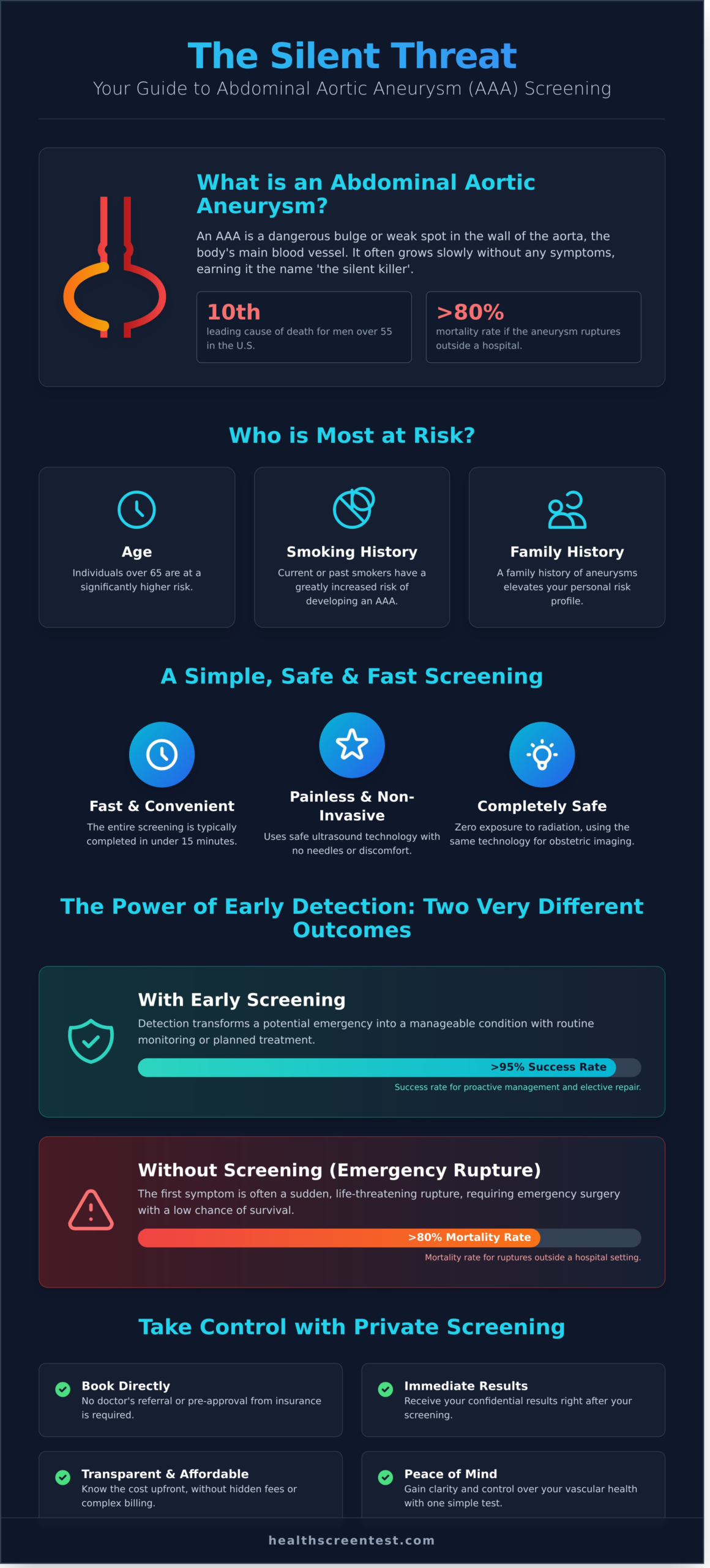
A ruptured abdominal aortic aneurysm is the 10th leading cause of death for men over 55 in the United States, yet it often develops without a single warning sign. It’s completely understandable to feel anxious about a silent threat you can’t see or feel, especially when faced with navigating the complex and costly hospital systems around Phoenix just for a preventative check. You deserve clarity and control over your vascular health without the bureaucracy and uncertainty.
This guide is designed to give you that control. We’ll show you exactly how a quick, non-invasive, and affordable abdominal aortic aneurysm screening Mesa can provide the definitive peace of mind you need to continue enjoying your active Arizona lifestyle. We will walk through who is most at risk, explain the simple ultrasound technology used for detection, and detail how you can access this life-saving screening with transparent pricing and immediate, confidential results.
Key Takeaways
- Learn why an Abdominal Aortic Aneurysm is often called a ‘silent killer’ and how a simple screening can provide critical, early detection.
- Understand the painless, radiation-free ultrasound technology used for screening and what to expect during your brief, non-invasive appointment.
- Discover the benefits of private abdominal aortic aneurysm screening Mesa, which allows you to book directly without needing a doctor’s referral or insurance pre-approval.
- Quickly identify the key risk factors, such as age and family history, to determine if you or a loved one should consider this proactive health measure.
Understanding the ‘Silent Threat’: Abdominal Aortic Aneurysm Screening in Mesa
An Abdominal Aortic Aneurysm, or AAA, is a localized bulge or swelling in the aorta, the main blood vessel that runs from your heart down through your chest and abdomen. Think of it as a weak spot developing on the wall of the body’s most critical pipeline. The primary danger of an AAA is its silence. It typically grows slowly and without any symptoms, earning it the name ‘the silent killer’. For many, the first and only symptom is a life-threatening rupture, an event with a mortality rate of over 80% outside of a hospital setting.
To better understand this concept and the simple screening process, watch this helpful video:
The goal is to catch this threat early. In communities like Mesa and Gilbert, where nearly 20% of the population is over the age of 65, the prevalence of AAA becomes a significant public health focus. The risk factors, including age, smoking history, and family genetics, are concentrated in our local demographic. The entire purpose of a preventative abdominal aortic aneurysm screening Mesa residents can access is to identify these aneurysms when they are small and can be safely monitored or managed. This weakening of the aortic wall creates a balloon-like bulge; for a more detailed medical overview, you can Learn more about Abdominal Aortic Aneurysm and its underlying pathology. This simple, proactive step transforms a potential emergency into a manageable condition, giving you control over your health outcome.
Key Takeaways: Why Mesa Residents Prioritize This Test
This brief, non-invasive test offers profound peace of mind. It’s a simple step with life-saving implications, which is why so many prioritize it as part of their annual wellness routine. Here’s a summary of the benefits:
- Fast and Painless: The screening utilizes simple ultrasound technology. The entire process is completed in less than 10 minutes with no needles, no radiation, and no discomfort.
- Clinically Proven Effectiveness: When an AAA is detected early, the success rate for proactive management and elective surgical repair exceeds 95%. This stands in stark contrast to the low survival rate of an emergency rupture.
- Unmatched Convenience: With mobile screening sites and partner clinics conveniently located across the East Valley, getting tested fits seamlessly into your schedule without requiring a disruptive trip to a hospital.
The Local Impact: AAA in Arizona’s Senior Communities
Mesa is celebrated for its vibrant and active senior population. It’s a common misconception, however, that a healthy lifestyle of golf, hiking, or swimming eliminates the risk of an AAA. While these activities are excellent for cardiovascular health, they don’t alter the primary risk factors: being over 65, a history of smoking, or a family history of aneurysms. Proactive screening isn’t a reaction to poor health; it’s a pillar of a smart, data-driven wellness strategy. Taking the initiative to get screened is a powerful act of personal health management, allowing you to take independent control of your long-term health journey with accurate, confidential information.
How Ultrasound Technology Detects AAA Without Pain or Radiation
As your guide through this process, I want to demystify what happens during an abdominal aortic aneurysm screening. Many patients arrive expecting a complex, invasive procedure. The reality is a remarkably simple, non-invasive process that uses the same safe technology used for decades in obstetric imaging. Our goal is to provide you with definitive answers in a discreet, comfortable environment, entirely free of needles, radiation, or the need to undress.
The screening itself is straightforward. You’ll be asked to lie comfortably on your back on an examination table. A skilled sonographer will apply a small amount of warm, water-based gel to your abdomen. This gel helps eliminate air pockets between your skin and the ultrasound transducer, ensuring the sound waves transmit clearly. The sonographer then gently presses the transducer against your skin, moving it to different positions to get a clear view of your abdominal aorta. You won’t feel anything more than light pressure. The entire imaging portion takes only 10 to 15 minutes.
The Science of the Screen: What the Sonographer Sees
The transducer sends high-frequency sound waves, inaudible to the human ear, into your body. These waves travel through tissue and bounce off your internal organs, including the aorta. The transducer captures these returning echoes, and a computer instantly translates them into a black-and-white, real-time image on a monitor. It’s a precise and dynamic way to see inside the body without any exposure to ionizing radiation. The sonographer’s primary task is to measure the maximum diameter of your aorta. A healthy abdominal aorta is typically less than 3.0 centimeters (cm) wide. An aneurysm is defined as a localized dilation of 3.0 cm or greater. This single, accurate measurement is the key data point that helps determine if you fall within the parameters outlined by the official USPSTF screening guidelines. It’s crucial to understand this is a detection tool; a positive finding simply means the condition has been identified, allowing for proactive monitoring, not immediate surgery.
Preparing for Your Appointment in Mesa
Preparing for your abdominal aortic aneurysm screening Mesa appointment is simple and requires minimal disruption to your day. We provide clear, concise instructions to ensure the highest quality imaging results:
- Fasting: We ask that you avoid eating or drinking for at least 4 hours prior to your screening. An empty stomach reduces the amount of gas in your intestines, which can otherwise block the sound waves and obscure the sonographer’s view of the aorta.
- Clothing: Wear a loose, comfortable two-piece outfit. You will only need to lift your shirt or blouse, allowing access to your abdomen while maintaining your privacy and comfort.
The screening is designed for efficiency. From the moment you arrive to the moment you leave, the process typically takes less than 30 minutes. There is no recovery time needed. You can immediately return to your normal Mesa activities, whether that’s heading back to the office or enjoying lunch. Understanding the simplicity and safety of the process is the first step. The next is to schedule your confidential appointment and gain that invaluable peace of mind.
Private Screening vs. Traditional Medical Routes in the East Valley
When you decide to be proactive about your vascular health, you face a critical choice: navigate the conventional healthcare system or opt for a direct-to-consumer private screening. The traditional path often involves a frustrating sequence of appointments, referrals, and insurance hurdles. The alternative offers a streamlined, patient-centric experience designed for speed, privacy, and peace of mind.
In the traditional model, getting an abdominal aortic aneurysm screening Mesa residents need often begins with a primary care visit. If your doctor agrees a screening is warranted, you’ll need a referral to a specialist, which can take time. In the Phoenix metro area, the average wait time to see a new specialist can be over three weeks. From there, you still need to schedule the imaging appointment and wait for insurance approval. This approval isn’t guaranteed. For example, the specific criteria for Medicare coverage for AAA screening are quite narrow, typically limited to a one-time screening for men with a smoking history. If you don’t fit the exact profile but still want the reassurance, you could face delays or an outright denial.
Bypassing the Clinical Waiting Room
Private screening eliminates these barriers. You don’t need a doctor’s referral or insurance pre-authorization to book your appointment. Health Screen Test provides direct access to professional Life Line Screening events held in convenient East Valley locations. These screenings take place in community settings, creating a relaxed, no-judgment atmosphere far removed from the sterile and often intimidating hospital environment. It’s a proactive choice you make on your own terms.
Understanding Your Results and Next Steps
After your screening, your confidential results are delivered directly to you, typically within 21 days, via a secure online portal or mail. This report is yours to keep. You own your health data. This empowers you to share the findings with your Mesa physician to establish a health baseline or, if an aneurysm is detected, to create an immediate and informed monitoring plan. This direct-access model is central to our mission of putting actionable health information directly into your hands, a philosophy you can learn more about on our About Us page.
Financially, the direct model is often more cost-effective. A single, a-la-carte ultrasound ordered through a hospital can easily cost several hundred dollars, particularly if you have a high-deductible insurance plan. In contrast, private screening services frequently offer comprehensive packages. You can bundle an abdominal aortic aneurysm screening with other critical vascular tests, such as those for carotid artery disease or peripheral artery disease, for a single, transparent price. This approach provides a more complete picture of your cardiovascular health without the financial uncertainty of the traditional system.
Am I at Risk? A Personalized Guide for Residents of Mesa and Scottsdale
Understanding your personal risk for an abdominal aortic aneurysm (AAA) isn’t about causing anxiety; it’s about empowerment. By identifying specific risk factors, you can take control of your vascular health with precise, proactive steps. The development of an AAA is not random. It’s closely linked to a distinct set of genetic and lifestyle-related indicators.
The most significant risk factors are clear and well-documented. If you live in the East Valley and are considering your health, review this checklist to see if you align with the primary criteria for screening:
- Age: The risk increases significantly after age 65. The aorta, like other body tissues, can weaken over time.
- Gender: Men are up to four times more likely than women to develop an AAA.
- Smoking History: This is the single most critical modifiable risk factor. Even a past history of smoking dramatically elevates your risk.
- Family History: Genetics play a key role. Having a first-degree relative (a parent or sibling) with an AAA can increase your own risk by as much as 20%.
Beyond these primary indicators, chronic conditions like high blood pressure (hypertension) and high cholesterol (hyperlipidemia) act as contributing factors. These conditions place continuous stress on the arterial walls throughout your body, including the aorta. Over years, this sustained pressure can weaken the aortic wall, making it more susceptible to dilating and forming an aneurysm. For this reason, a comprehensive abdominal aortic aneurysm screening Mesa residents can access should be considered a vital part of managing overall cardiovascular health, not just an isolated test.
The Smoking Connection: Even ‘Former’ Smokers Need to Know
Quitting smoking is one of the best decisions you can make for your health, but the vascular damage it causes is cumulative and can persist for decades. The U.S. Preventive Services Task Force (USPSTF) specifically recommends a one-time ultrasound screening for all men aged 65 to 75 who have ever smoked 100 or more cigarettes in their lifetime. This recommendation underscores that your past choices inform today’s health needs, and screening is a forward-looking, powerful action you can take now.
Vascular Health Beyond the Aorta
An AAA is often a sign of a systemic vascular issue called atherosclerosis, or hardening of the arteries. This means if your aorta is affected, other critical arteries may be as well. It’s frequently linked to Carotid Artery Disease (a major risk factor for stroke) and Peripheral Artery Disease (PAD). For a complete picture of your health, our ‘Stroke & Cardiovascular’ package offers a comprehensive assessment. You can learn more about these interconnected conditions on our Blog.
If you reviewed the list above and recognized yourself in one or more of the risk profiles, the path forward is clear and simple. Don’t leave your health to chance. Taking proactive steps provides peace of mind and the critical data you need for a longer, healthier life. Explore our confidential and accurate Screenings options to find the right preventive test for you today.
Taking Control: Booking Your AAA Screening at a Mesa Mobile Location
Proactive health management shouldn’t be complicated. We’ve engineered our booking process to be as seamless and stress-free as the screening itself. You can secure your appointment and gain invaluable peace of mind in just a few minutes, giving you complete control over your health schedule. Our system is designed for your privacy and convenience, ensuring that taking this vital step is straightforward and reassuring.
The entire online booking journey is completed in three simple steps:
- Select Your Service: Choose the comprehensive Primary Cardiovascular package, which includes your vital abdominal aortic aneurysm screening. All test details and biomarkers are clearly explained, so you know exactly what you’re investing in.
- Provide Secure Payment: Our encrypted payment portal accepts all major credit cards and HSA/FSA accounts, ensuring your financial data is as secure as your health data. The process is quick and transparent, with no hidden fees.
- Choose Your Mesa Location: This is where convenience becomes reality. View our calendar of mobile screening events across Mesa and select the time and location that best fits your routine.
We strategically position our state-of-the-art mobile clinics at accessible community hubs throughout Mesa. You might find us conveniently located near the Mesa Arts Center on a weekday morning or situated at a major shopping plaza like Dana Park on a weekend. This approach removes the typical barriers to preventative care, like hospital parking or navigating large medical complexes. An abdominal aortic aneurysm screening Mesa appointment can now fit into your day as easily as a trip to the grocery store.
Your privacy is paramount. From the moment you book to the delivery of your results, every step is governed by strict HIPAA-compliant protocols. Our discreet mobile clinics and professional staff ensure your screening experience is confidential and comfortable. We provide the clinical accuracy of a hospital setting with the privacy and ease you deserve.
What Our East Valley Neighbors Are Saying
“My doctor mentioned I had risk factors, but I kept delaying a screening. I saw the HealthScreen mobile van near Pioneer Park and booked on my phone right there. The team was professional, the process took 15 minutes, and the peace of mind I got was immediate. It’s a fantastic service for our community.”
– David L., Mesa Resident
You are not alone in taking this proactive step. In 2026, over 5,000 Arizona residents utilized private screening to monitor their vascular health. As your Trusted Expert Guide, we encourage you to join them in prioritizing your well-being.
Ready to Start? Contact Us or Book Today
If you have specific questions about our services or need help determining the right screening for you, please visit our Contact Us page to connect with our dedicated care team. To learn more about the condition itself, watch this informative overview from the Society for Vascular Surgery.
Don’t wait for symptoms to appear. Take decisive action for your long-term health today by booking our Primary Cardiovascular package. It is the most direct path to understanding your vascular health and securing your future.
Your Next Step to Vascular Health in Mesa
An abdominal aortic aneurysm often presents no symptoms until it becomes a medical emergency. You’ve learned that a painless, 15-minute ultrasound can detect this silent threat, and that private screening offers a direct, confidential path to gaining crucial health insights. This knowledge empowers you to move beyond uncertainty. For at-risk individuals, a proactive abdominal aortic aneurysm screening Mesa isn’t just a test; it’s a definitive step toward long-term wellness and peace of mind.
Join a trusted partner network that has already provided vital health data to over 10 million people nationwide. You don’t need a doctor’s order to book, and your accurate results are delivered directly and privately to you. The process is seamless and designed for your complete convenience.
Book Your Lifesaving AAA Screening in Mesa Today and take confident control of your health journey.
Frequently Asked Questions About AAA Screening
Is an AAA screening covered by Medicare in Mesa?
Yes, Medicare Part B provides a one-time, no-cost abdominal aortic aneurysm screening for qualified individuals. This benefit is typically offered during the “Welcome to Medicare” preventive visit within the first 12 months of enrollment. To be eligible, you must have a specific risk factor, such as a family history of AAA or, for men aged 65-75, a history of smoking at least 100 cigarettes. We can help you confirm your eligibility and schedule your screening.
How long does the abdominal aortic aneurysm screening take?
The entire screening process is quick and efficient, typically completed in under 30 minutes from check-in to finish. The actual ultrasound scan, during which a trained sonographer captures precise images of your aorta, takes only 10 to 15 minutes. We’ve streamlined our process to respect your time, providing a seamless experience that delivers critical health insights without disrupting your day. Our goal is a stress-free path to proactive health monitoring.
Do I need a doctor’s prescription for a screening at Health Screen Test?
No, a doctor’s prescription is not required for an AAA screening at Health Screen Test. We believe in providing you with direct access to vital health information, empowering you to take proactive control of your wellness journey. You can book your appointment at your convenience. After your screening, we provide a comprehensive report that you can easily share with your primary care physician to coordinate any necessary follow-up care, ensuring a fully integrated approach to your health.
What happens if the screening finds an aneurysm?
If the screening detects an aneurysm, our clinical team provides you with a detailed report and clear guidance on the next steps. For small aneurysms, typically less than 5.5 cm, your physician will likely recommend a monitoring plan with repeat screenings every 6 to 12 months. If a larger aneurysm is found, we will strongly advise you to consult your primary care physician or a vascular specialist immediately for further evaluation and to discuss potential treatment options.
Are there any side effects to the ultrasound procedure?
No, there are no known side effects associated with an abdominal ultrasound. The procedure is completely non-invasive and painless. It uses safe, high-frequency sound waves, not radiation, to create images of your aorta. The only sensation you’ll feel is the technician applying a water-based gel to your skin and gently moving a small probe across your abdomen. The gel might feel slightly cool but is harmless and wipes off easily after the scan.
Can I eat or drink before my AAA screening appointment?
To ensure the highest accuracy, we recommend you fast for at least 4 to 6 hours before your screening. An empty stomach reduces the amount of gas in your intestines, which can otherwise obscure the sonographer’s view of the aorta and affect the clarity of the ultrasound images. You may drink small amounts of water, but please avoid all other food and beverages, including coffee and chewing gum. This simple step helps us provide the most reliable results.
How often should I get screened for AAA if I live in Mesa?
For most at-risk individuals with a normal initial result, a one-time screening is often sufficient, aligning with guidelines from the U.S. Preventive Services Task Force. However, if a small aneurysm is detected, your doctor will likely recommend a surveillance schedule with repeat screenings every 6 to 12 months. Your personal risk profile determines the best frequency for an abdominal aortic aneurysm screening Mesa residents can rely on for peace of mind and proactive health management.
Where are the mobile screening locations in the East Valley?
Our mobile units provide convenient abdominal aortic aneurysm screening Mesa and other East Valley cities, including Chandler, Gilbert, and Tempe. We partner with local businesses, community centers, and select pharmacies to bring our services directly to you. For example, we host events at the Mesa Active Adult Center on the first Tuesday of each month. To find the location nearest you, please view the up-to-date schedule and book your appointment directly on our website’s mobile events page.

Article by
Alexander Aquino, RN
With over 35 years of dedicated service within the healthcare industry, I've witnessed firsthand the profound difference early detection can make in saving lives. This experience has ignited my mission to empower individuals to take control of their healthcare before challenges arise.
Throughout my career in both nursing and medicine, I have worked in inpatient hospitals and outpatient clinical settings. I've dedicated myself to one unwavering principle: prevention saves lives. Every day in healthcare reinforces this truth—the earlier we detect potential health issues, the better the outcomes for patients.
Disclaimer
Health Screen Test does not provide medical advice, diagnosis, treatment, or prescription services, nor does it bill insurance. The content presented in this blog is intended solely for educational purposes to help you make informed decisions before purchasing any screening tests. By clicking on an affiliate link, you will be redirected to the respective screening company’s website. Please consult your physician for personalized medical advice. Kindly note that I may receive a small commission from purchases made through affiliate links.